
Map Condenser Fin, Tube and Modulator Damage Separately
Map condenser fin, tube, tank and applicable integrated-component concerns separately so a bent-fin explanation does not erase an unresolved integrity question.
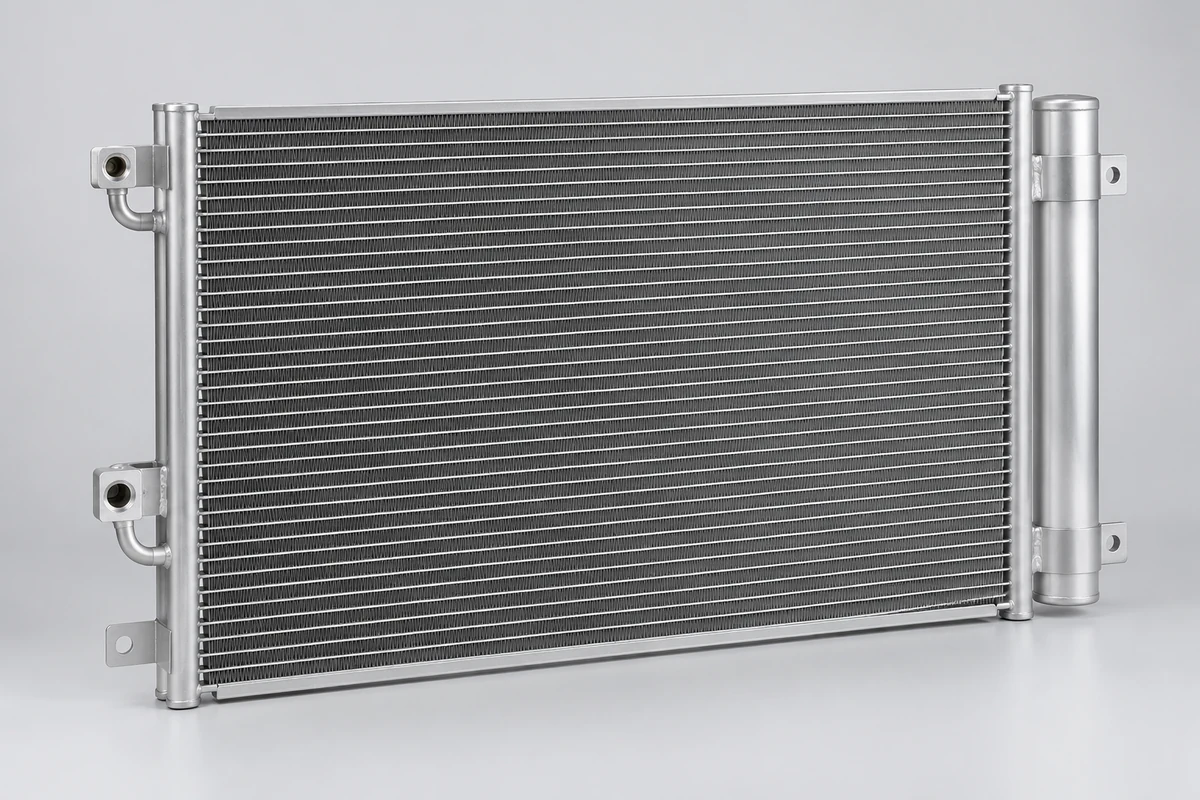
A condenser that arrives with a folded fin area and a dent beside a tank needs two location-specific entries. Calling the whole concern “bent fins” hides the part of the assembly that still needs a separate technical answer. Map each visible anomaly against the actual delivered design before debating whether any of it is cosmetic.
This record concerns a dry, unused condenser whose identity has already been specified. It does not approve a pressure circuit from photographs, set a bent-fin allowance or instruct anyone to straighten the assembly.
Name the assembly zones before grading the damage
DENSO’s condenser overview describes tubes and tanks in multi-flow designs and an integrated gas-liquid separator or modulator in its super-cool designs. That structural context helps buyers ask which part is affected. It does not establish that every delivered condenser has the same arrangement or an integrated modulator. DENSO condenser types
Use the approved assembly reference to identify the actual zones. Where an integrated component is present, retain its name from the product information rather than guessing from a cylindrical outline. If the unit’s configuration is unclear, ask for the correct drawing or description before attaching a confident component label.
Keep a fin-only observation distinct from one involving an apparent tube, tank, joint or integrated component. An image may be insufficient to tell which structure is affected at a boundary. In that case, write “location crosses fin/tube area; exact extent unresolved” rather than selecting the easier category.
Build a map that locates, rather than measures
Choose a consistent whole-assembly view and label its orientation using visible ports or mounting features. A non-dimensional sketch or an annotated copy can point to zones A and B while preserving the original image. These zone names are evidence references, not engineering datums or measured dimensions.
For each zone, record the visible form: folded fins, a dent-like feature on a tank, an uncertain line near a joint, or an inaccessible region. Retain the level of certainty in the wording. A dark line in an angled view is not a confirmed crack, and a shallow-looking depression is not a measured shallow dent.
Use the actual product to orient the map without moving or manipulating suspect areas merely to obtain symmetry. Do not insert a tool between fins, straighten them or remove an integrated component. A close-up that requires changing the condition defeats the purpose of the arrival record.
The unseen reverse side is not automatically clear. State which views exist and which areas remain unassessed. A neat whole-unit photograph cannot establish every tube or joint condition, and it cannot prove leak-tightness.
Packaging contact is context, not a fault verdict
Link a relevant restraint or carton contact point to the assembly view when that relationship is known. A contact mark at the same apparent location can help the supplier understand the concern, but the picture alone may not establish when it occurred or who caused it.
Keep two kinds of uncertainty explicit: the technical extent of the anomaly and the cause of the event. A supplier may accept responsibility for shipping while the technical status remains unresolved. Conversely, a qualified technical assessment may classify the condition without deciding commercial liability.
Do not allow a guessed percentage of bent fins to clear another zone. Even if an actual agreement includes a product-specific fin criterion, it must be applied only within its authorized scope and must not become a tank-dent rule. This article supplies no such criterion and no pressure or leak-test instructions.
A multi-zone condenser worksheet
This original worksheet gives the supplier a set of distinct questions rather than one overall damaged/not-damaged checkbox.
| Field | Entry to retain | Question that remains separate |
|---|---|---|
| Assembly identity | Exact reference and actual configuration | Does the drawing cover this delivered unit? |
| Fin zone | Location on the oriented view and plain observation | Applicable fin-condition assessment |
| Tube/tank zone | Separate location and visible anomaly | Pressure-circuit integrity and technical disposition |
| Integrated component | Actual presence, identity and observation | Whether a different component is involved |
| Packing contact | Known original contact relation | Cause and responsibility, if not established |
| Evidence limits | Unseen areas and ambiguous boundaries | Scope of further competent assessment |
One unit can have several zone rows. Keep them linked without merging their outcomes. If a response says “fins acceptable,” ask which map references it actually covers before closing any tank or joint concern.
Fictional counterexample: two zones cannot share one cosmetic answer
A fictional condenser K-2 arrives with a localized fin fold in zone A and a separate dent-like feature on its tank in zone B. The supplied design has an integrated modulator, which is visible but not the site of either reported anomaly. All identifiers and events are invented.
The seller replies that the damage is cosmetic because only a small area of fins is bent. That explanation does not address zone B. The buyer keeps K-2 held for a product-specific response to the tank concern and records the limited scope of the seller’s fin statement. No percentage is invented and no attempt is made to straighten zone A.
Suppose the supplier later sends a pressure-test certificate from production. The reviewer must determine whether it is applicable to K-2 and what time and condition it covers. A record from before the arrival event does not, by itself, answer the later tank observation. This does not prescribe a new test; it identifies the gap in the offered evidence.
If replacement is agreed, give the replacement a separate arrival record. The original zone map remains useful for the claim and future packing discussion, without being presented as proof of the replacement’s condition.
Ask for the technical scope explicitly
A usable disposition identifies each affected zone, the evidence reviewed and the limits of the conclusion. Manufacturer performance claims for a named range cannot be transferred to an unknown supplier’s dented unit. The buyer should finish with an exact assembly outcome and any remaining integrity questions, not a generic promise that the condenser will probably work.
Keep the buying request tied to the actual part
For category context, see Cooling parts; the supplier-check guide covers the earlier supplier review. Independent aftermarket or unbranded sourcing and authorized drawing-based proposals require their own product evidence. The manufacturer cited here is a documentary example, not an affiliation, branded-goods offer or endorsement of another supplier.
Start an Autoparts sourcing request with the exact received reference and the unresolved question. The form accepts an 8–1200-character description and up to five PNG, JPEG, WebP or GIF images, at most 10 MiB each and 20 MiB total. PDF, CAD and ZIP uploads are not supported. Arrange other technical files through a separately agreed, authorized exchange. Buying coordination and supplier negotiation do not establish an owned laboratory, an inspection service, engineering approval or a guaranteed remedy.
Frequently asked questions
Can a small bent-fin area be accepted using a universal percentage?
This article provides no percentage or universal acceptance threshold. Use only applicable, agreed product-specific criteria through the responsible reviewer. A fin criterion would still not resolve a separate tank, tube or joint concern.
Does a clean-looking condenser prove it is leak-tight?
No. Exterior views record visible condition within their coverage. They do not establish pressure-circuit integrity, thermal performance or internal condition. Required technical evidence needs its own scope and applicability review.
Should the integrated modulator be included in the damage map?
Include it only where the actual delivered design has one, using the product information to identify it. Record its observation separately when relevant. Do not assume every condenser has the same construction or remove a component for the receiving review.
Does a factory pressure-test record settle an arrival dent?
Not automatically. The responsible reviewer must check the unit linkage, date and condition covered by the record. Evidence from before a later event may leave the arrival concern unanswered; this worksheet does not prescribe a new pressure test.
Sources
Discuss a sourcing request related to this article.Map Condenser Fin, Tube and Modulator Damage Separately