
Hold Contaminated MAF Sensors Before a Cleaning Attempt
Hold a visibly contaminated MAF sensor in its original state and separate passage debris, seal condition and handling history before any cleaning proposal.
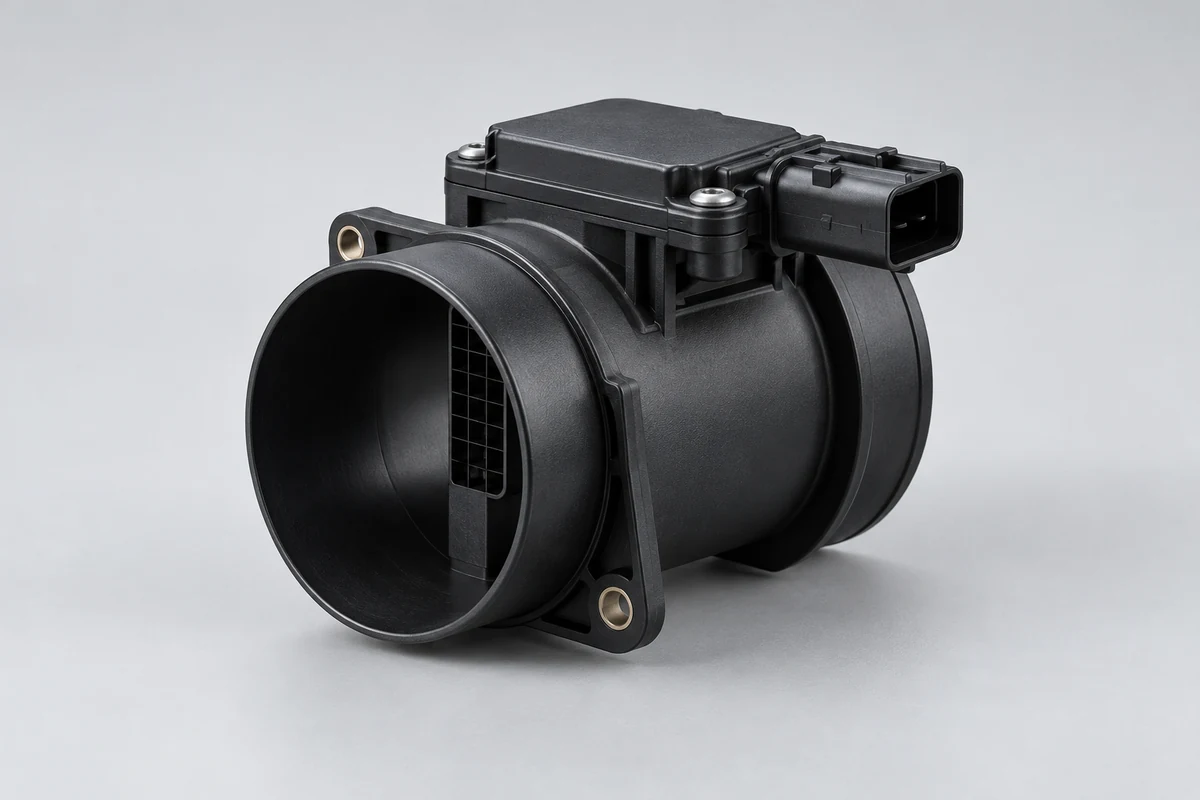
Visible debris at a newly delivered mass air flow sensor’s passage is a reason to preserve that unit’s condition, not a prompt to spray it clean. An intact connector label answers neither the contamination question nor the condition of the airflow-sensing hardware. Keep the affected unit identifiable while the supplier explains the supplied state and proposes a documented outcome.
For this receiving review, the application and ordered sensor are already established. The task is to decide what evidence is needed for an arrival-contamination concern without turning a warehouse observation into a repair attempt.
Why continued operation would not settle contamination
DENSO explains that a damaged or contaminated MAF sensor may still function while its characteristics have changed. Its fault-finding guidance also cautions that cleaning may damage delicate sensor hardware. Those service statements support caution about improvised cleaning; they do not diagnose a newly delivered unit from a photograph or provide a contamination acceptance limit. DENSO MAF sensor guidance
A supplier’s claim that a sensor “still works” therefore does not answer what was delivered. Even an identifiable operational record would need the appropriate method, criteria and product scope before the responsible reviewer could use it. A video of another sensor working is further removed from the actual arrival condition.
Do not translate service causes into a receiving diagnosis. DENSO’s discussion of filters and contamination during operation does not establish why debris is present in an unused shipment. Packing material, prior handling and an unknown deposit are evidence subjects to investigate, not conclusions to choose in advance.
Describe the passage without entering it
Use safe, accessible views of the passage and exterior. Identify the product reference and the direction of the photograph using a visible housing feature. This makes “debris at the opening” more precise without asking anyone to insert a probe or move the sensing element.
Separate material visible on the surrounding packaging from material visible at or within the accessible passage. Similar appearance does not establish that both came from the same source. A packing fragment beside the unit and a fragment at its passage are different locations with different evidentiary significance.
Record an accessible supplied seal separately: whether it is visible, appears displaced, has an observable tear, or cannot be assessed. A clean-looking seal does not clear the passage, and a passage photograph cannot establish the condition of a concealed seal. Do not remove the seal or dismantle the housing to complete the record.
Keep the actual observation scope narrow. “No debris visible in the available opening view” is different from “internally clean.” Areas outside the view stay unassessed. Avoid a percentage-contamination score that implies an acceptance method nobody has agreed.
A cleaner photograph can be worse evidence
Spraying, blowing, brushing or touching a suspect area changes the as-received condition. It may also move debris away from its original location. The buyer then has a new history to explain while still lacking a technical basis for acceptance.
If a seller proposes cleaning, ask it to address the original receiving question first: does the observed condition agree with the supplied requirement, and what product-specific remedy or qualified assessment does it propose? Record that suggestion without treating it as authorization to perform the work. A warehouse should not improvise an airflow or voltage test to decide whether cleaning helped.
If cleaning has already occurred, preserve the earlier images and the reported action, including who performed it. Do not omit that fact when requesting disposition. A later tidy view may be useful as a later view, but it must not replace the original image in the arrival record.
A passage-contamination worksheet
This editorial worksheet is designed to stop three different questions from collapsing into one “clean” checkbox.
| Record | Evidence to retain | Separate question |
|---|---|---|
| Sensor identity | Ordered and delivered code, unit/package link | Does the record cover the actual unit? |
| Passage observation | Location of visible material in an accessible view | Is its nature or effect established? |
| Seal observation | Visible supplied-seal state or not assessed | Is there a distinct seal discrepancy? |
| Packaging relationship | Material and original packing locations | Is a common source proven or only suspected? |
| Prior handling | Known actions before and after the first photo | Has the condition been altered? |
| Technical response | Exact-unit explanation, limits and proposed outcome | What evidence still blocks acceptance? |
Record absent information explicitly. “Supplier handling declaration requested” is better than assuming a never-opened history from a sealed outer carton. Any inward assessment beyond this record belongs to an agreed competent provider, not a new receiving experiment.
Fictional counterexample: an intact connector and a spray suggestion
A fictional MAF unit M-6 arrives with loose packing-like fragments visible at its passage. Its connector shell and label show no visible issue. The seller sends an image of a clean sensor of the same general type and suggests a spray clean. All units and events here are invented.
The buyer records the passage condition and leaves the connector observation in its own field. The clean stock image is retained only as the seller’s reference, not substituted for M-6. The spray suggestion does not resolve whether M-6 was supplied in the agreed condition or what technical evidence is needed.
Suppose the supplier later agrees to consider an exact-unit return while continuing to call the connector satisfactory. The return proposal can progress under agreed terms, but the connector statement adds nothing to the unresolved passage condition. If replacement is agreed, the replacement receives a new identity and arrival review; it does not inherit acceptance from the cleaner stock image.
Finish with a condition answer, not a cleanliness promise
Ask the responsible reviewer to state what the available evidence can establish and what it cannot. The possible outcome may remain an unresolved condition pending an agreed assessment. A clear boundary is more useful than declaring the sensor restored, calibrated or fit because visible debris is no longer present.
Keep the buying request tied to the actual part
For category context, see Engine parts; the supplier-check guide covers the earlier supplier review. Independent aftermarket or unbranded sourcing and authorized drawing-based proposals require their own product evidence. The manufacturer cited here is a documentary example, not an affiliation, branded-goods offer or endorsement of another supplier.
Start an Autoparts sourcing request with the exact received reference and the unresolved question. The form accepts an 8–1200-character description and up to five PNG, JPEG, WebP or GIF images, at most 10 MiB each and 20 MiB total. PDF, CAD and ZIP uploads are not supported. Arrange other technical files through a separately agreed, authorized exchange. Buying coordination and supplier negotiation do not establish an owned laboratory, an inspection service, engineering approval or a guaranteed remedy.
Frequently asked questions
Can a MAF sensor operate despite contamination?
DENSO says a contaminated or damaged sensor may still operate with changed characteristics. That is service context, not a diagnosis of your unit. It explains why a simple operational assurance does not close a receiving-contamination concern.
Should packing fragments be blown out before photographs?
Do not blow, brush, spray or probe the passage as a receiving remedy. Preserve the accessible original view and request product-specific disposition. Moving the fragments changes their location and can make the arrival record less useful.
Does a clean connector mean the sensor was protected adequately?
It answers only the visible connector observation. The passage, supplied seal and relevant packaging need separate records. Neither a clean connector nor an intact label establishes internal cleanliness, calibration or sensing performance.
What if the supplier says cleaning is its normal remedy?
Ask for an answer tied to the delivered unit and the agreed supply condition before any action. A proposed remedy is not proof that it is appropriate or authorized. Technical work, commercial terms and the record of original condition remain separate decisions.
Sources
Discuss a sourcing request related to this article.Hold Contaminated MAF Sensors Before a Cleaning Attempt