
Coolant Reservoir Cap RFQ: Function Before Diameter
Distinguish the required nonpressurized reservoir cap, closure and venting scope from a similar-looking pressure cap before comparing prices.
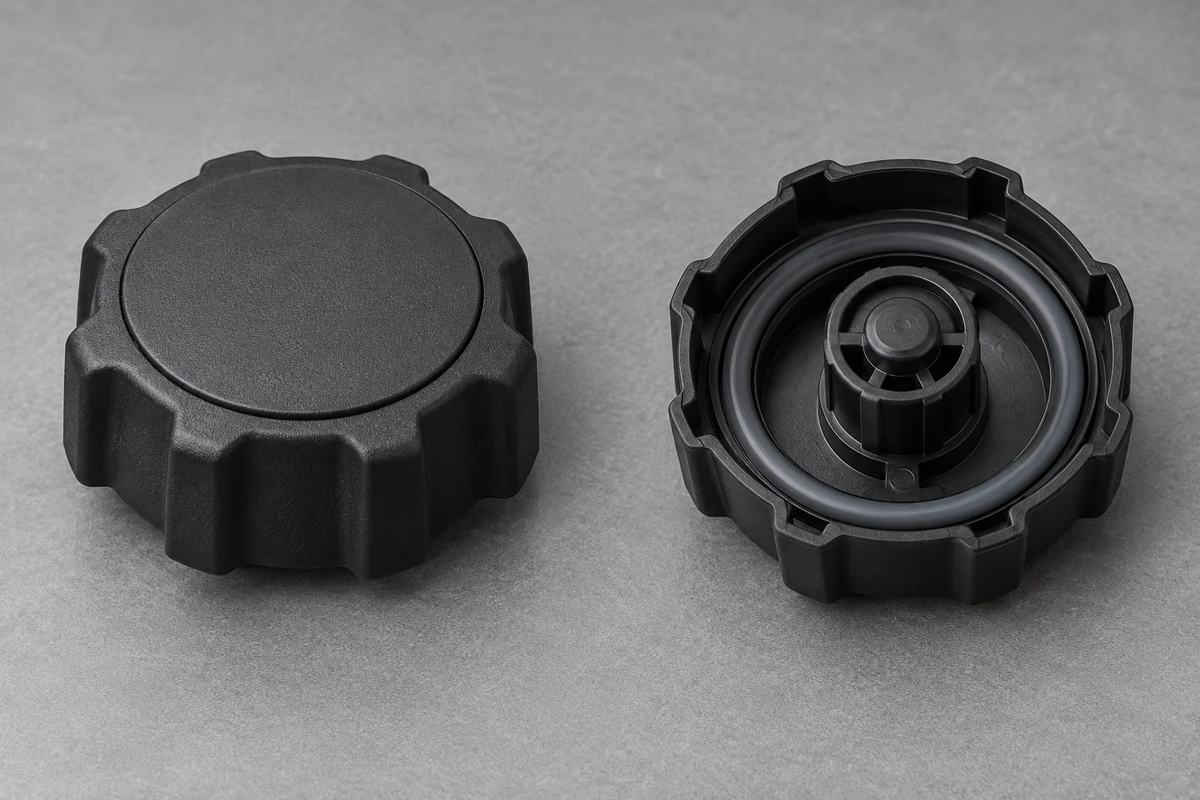
A coolant reservoir cap should be identified by its required function and closure, not selected by colour or a nominal diameter alone. If the authorized application requires a nonpressurized reservoir cap, a similarly sized pressure-cap offer is a different proposal. Keep that distinction visible before negotiating an affordable alternative.
Begin with the actual reservoir/application reference and the cap function established by the responsible technical source. This RFQ is not a method for choosing a pressure setting, opening a cooling system or testing a substitute cap.
Read pressure role, closure and venting together
Dorman’s 54201 specifications describe a nonpressurized, vented, snap-fit cap with a flip-top form. They list polypropylene, a 40 mm diameter and one cap in the package. These details describe that product, not every yellow reservoir cap or every 40 mm closure. Dorman 54201 cap specifications
The example is useful because the functional fields sit beside the visible features. A supplier who repeats the colour and diameter has not necessarily answered the cap’s pressure role or closure arrangement. A pressure-release-lever field also should not replace the separate pressurized/nonpressurized field.
For another application, preserve its own authorized requirement. Do not copy this example’s nonpressurized state or nominal diameter into an unrelated reservoir request. If the actual system role is unknown, resolve that question before asking suppliers for a matching cap.
Make the interface record more specific than “fits the neck”
Identify the authorized reservoir reference and the cap’s required closure type. Where a drawing defines the interface, use its exact revision and feature references. Ask the supplier to identify the corresponding information for the cap it actually offers. Do not create a precise mating profile by scaling a photograph.
Keep nominal diameter separate from the full closure/interface description. A single diameter cannot establish the shape or engagement of a snap-fit or another closure. If the seller proposes a different closure, record it as a changed product rather than treating it as an equivalent way to achieve the same nominal size.
Venting also needs an explicit response tied to the offered cap. The buyer should neither infer it from a visible opening nor invent a functional specification from the word vented. The responsible reviewer needs the application-specific information required to assess the actual proposal.
A cap-function worksheet
| Field | Authorized buyer basis | Supplier answer to request |
|---|---|---|
| Reservoir/application | Exact reference and variant | Offered cap identity and supported application |
| Pressure role | Required function | Explicit pressurized/nonpressurized description |
| Closure | Approved closure/interface | Actual offered arrangement and relevant drawing |
| Venting | Required application-specific scope | Offered description and supporting evidence |
| Nominal dimensions | Controlled feature names and units | Corresponding features, with gaps identified |
| Supplied object | Required cap contents | Actual included item and any exclusions |
| Open questions | Responsible reviewer | Unresolved function or interface evidence |
Do not let a supplier’s general “same fit” response answer every row. The worksheet separates function from appearance and from documentary completeness. It is an original purchasing aid, not a cap-selection standard.
Fictional comparison: identical colour, conflicting function
A fictional buyer has an authorized requirement for a nonpressurized reservoir cap with a defined closure. Offer A is a similarly coloured cap described as a pressure cap and gives a matching headline diameter. Offer B explicitly states the required nonpressurized function but omits evidence of its closure interface. Neither offer is real and no cap is accepted in this example.
A conflicts with the required function. Its colour and diameter cannot remove that conflict. The buyer asks for an application-supported offer on the original basis, if available, and does not consider an improvised test or a pressure-setting choice as a way to salvage A.
B is incomplete on interface evidence. Ask for the actual cap’s relevant drawing or supported application detail. A correct function description does not prove that it closes on the identified reservoir. If B later proposes a different closure, preserve that as a new deviation instead of combining it with its earlier matching-function answer.
The result is not a ranking of cap quality. It is a clear separation between a function mismatch and an unanswered interface question. A low-cost item still requires those distinctions when its role matters to the application.
Request an unchanged-function alternative
Ask for the same required function and closure first, with actual quantity and price terms. If the seller proposes an unbranded or drawing-based cap, require its own identified scope and supporting evidence. Do not assume that a mould copied from an outline reproduces the required function, or claim that a supplier already has suitable tooling.
A commercial alternative can be discussed without promising a saving. Keep any material, closure or functional change in a separately identified proposal for the responsible reviewer. A purchasing coordinator should not approve an unknown interface merely because the cap looks simple or inexpensive.
Close the RFQ clarification when the offered cap, functional role and closure basis are explicit, with unresolved questions assigned. Actual application suitability remains subject to the appropriate technical acceptance. The buying record should never imply permission to substitute a pressure cap for a nonpressurized requirement.
Prepare the sourcing request
For the broader product group, see Cooling parts. If the application is not established, start with the OE and application identification guide before asking for a substitute.
Use the Autoparts sourcing request to describe the required item and the particular question left open above. The form accepts a description of 8–1200 characters and up to five PNG, JPEG, WebP or GIF images, limited to 10 MiB each and 20 MiB total. It does not accept CAD, PDF or ZIP attachments. Authorized drawing images can start a discussion; arrange other technical files separately through an actually agreed, authorized exchange.
Keep requests for independent aftermarket or unbranded alternatives tied to the authorized application or drawing. Supplier negotiation and a drawing-based proposal do not establish engineering acceptance, actual manufacturing capability or guaranteed savings. Named catalogue products in this article are documentary examples, not branded-goods offers or approvals of an unknown alternative.
Frequently asked questions
Can I select a coolant reservoir cap by colour and diameter?
No. Those features do not establish its required pressure role, venting or closure interface. Begin with the authorized reservoir/application reference and request the actual offered cap’s functional and interface information.
Is a nonpressurized cap interchangeable with a pressure cap?
Do not treat them as interchangeable. They describe different functional scope. If the approved requirement calls for one type, preserve that requirement and obtain an application-supported proposal rather than choosing by appearance or a nominal size.
Does vented identify the full cap specification?
No. Record venting alongside the pressure role, closure and authorized application, and request whatever product-specific evidence the responsible reviewer requires. The word alone does not supply a complete functional or interface specification.
What should a drawing-based cap proposal disclose?
It should name the authorized drawing and offered cap, identify the actual closure and functional scope, and list material or geometry changes separately. A drawing proposal is not evidence of existing tooling, manufacturing capability or accepted performance.
Sources
Discuss a sourcing request related to this article.Coolant Reservoir Cap RFQ: Function Before Diameter