
Timing Kit Packaging: Preserve Application-Specific Additions
Keep approved timing-kit additions tied to the exact kit reference when range-level descriptions, omitted packets or a repacking revision create uncertainty.
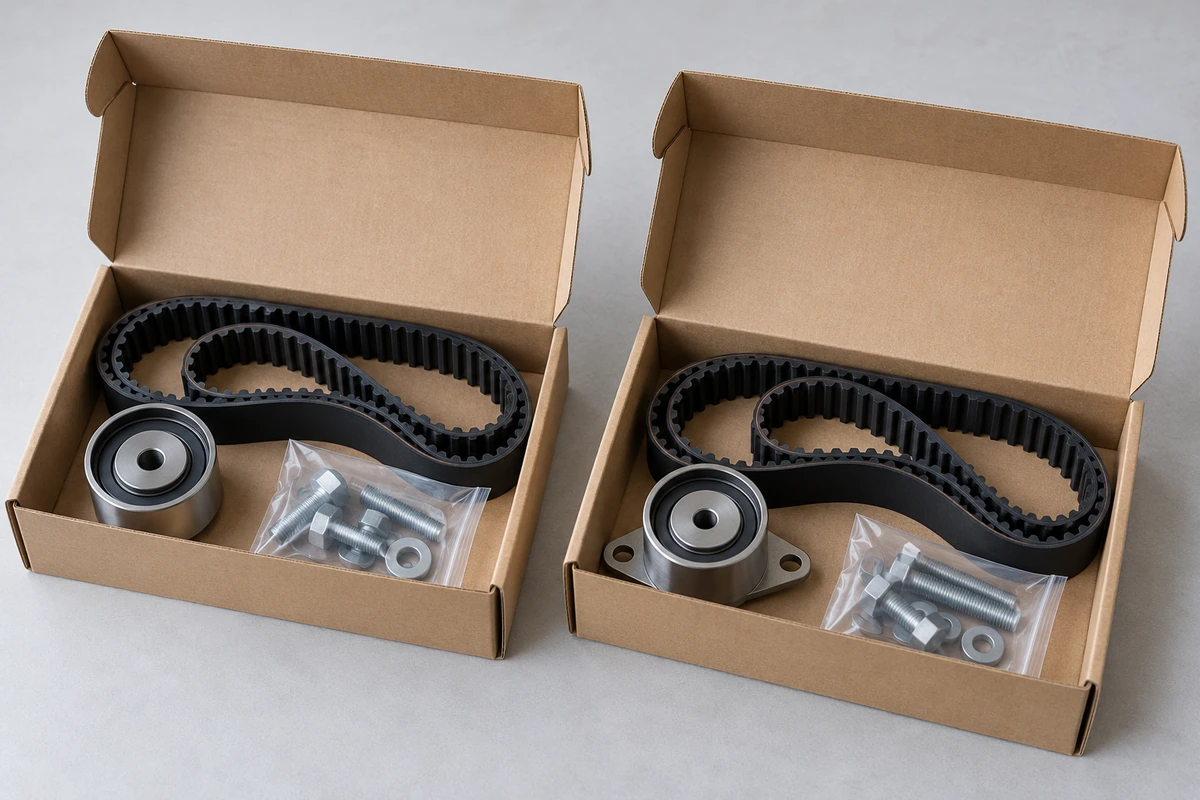
Before consolidating approved timing kits, resolve any packing response that replaces their exact addition schedules with a range-level description. A phrase such as tools and gaskets where required does not tell the packer which approved kit receives which addition. The buyer needs to preserve the decision already made for each application, including additions that legitimately differ between nearby kit references.
This review starts after the application and purchased scope are approved. It asks whether the proposed inner-pack record still represents that scope. It does not select timing components, create an engine-kit bill of materials or determine which service tools a repair requires.
Range availability and inclusion on this kit answer different questions
Gates’ US English PowerGrip Kits Plus Water Pump page describes timing-drive components with a water pump and vehicle-dependent additions, including certain tools, hardware, gaskets and information. Checked on 14 October 2026, it illustrates why a range description leaves an application-specific question. It does not provide the contents of every kit or an alternative supplier’s bill of materials. Gates kit description
For the actual order, retain the accepted reference that establishes whether an addition belongs to this kit. Distinguish three answers: included on this approved kit, outside this approved kit’s scope, and unresolved in the new packing response. The third answer does not cancel the earlier agreement; it identifies a clarification needed before the packing revision can represent it accurately.
The word optional is especially risky when copied between records. It may describe a choice offered across a product range, or it may refer to a buyer-selected addition already included in a particular order. Ask the provider which meaning applies. A packaging summary should not turn a purchased addition into a discretionary item.
Preserve the eligible addition, not a generic bag name
The accepted kit record may distinguish physical additions from included information. Keep the identity and applicability of each relevant group attached to the parent kit. A generic label such as timing accessories can conceal a changed gasket group, a different supplied tool or a document meant for another kit revision.
A document’s presence is not enough if its applicability is uncertain. Record the actual agreed document reference and supplied form, where documentation is included in the order. Do not invent a printed-copy requirement for an electronic supply, or substitute a visually similar instruction sheet because its title mentions the same broad engine family.
Likewise, an addition absent from one approved kit is not automatically a shortage. The exact kit-specific scope governs that finding. A photo of a related kit with a tool cannot establish that the purchased variant must contain the same tool. Request the applicable contents answer rather than standardizing every inner pack to the most elaborate catalogue image.
Compare the packing revision with the accepted contents evidence
Ask the provider to identify the exact kit reference and contents issue that its proposed inner-pack description uses. If it cites only a product-family webpage, request the missing connection to the already accepted order. Keep the existing approval reference available so the question is about preserving supply rather than starting the product selection again.
Where the provider says a kit reference or contents issue has changed, record that as an explicit proposed revision. Ask which additions and applicable information change with it. The packing team should not carry the old parent reference onto a new assortment merely because the belt and pump counts remain the same.
This distinction also helps resolve a late shortage. If an addition is confirmed included but unavailable, record a supply gap for that kit. If a provider proposes an alternative addition, retain it as a product-scope change pending the responsible decision. Neither a new bag label nor a common accessories carton can resolve the underlying eligibility question.
Use an application-to-addition cross-check
This editorial worksheet compares the actual accepted kit evidence with the current packing proposal. It is not a manufacturer contents schedule or a repair checklist.
| Field | Answer to preserve |
|---|---|
| Exact approved kit | Parent reference, application variant and accepted contents issue |
| Addition group | Actual physical or documentary reference, where included |
| Inclusion basis | Included on this kit, expressly excluded, or clarification needed |
| Applicability evidence | Provider record tying that addition to this exact kit issue |
| New packing description | Current inner-unit reference and any changed or generic wording |
| Open decision | Missing supply, proposed revision or unresolved applicability, with owner |
The record should distinguish a confirmed exclusion from missing evidence. Blank entries should not silently become not required. Where the original contents decision is clear but the pack response is vague, ask the provider to restore the exact relationship in the packing record rather than sending the buyer back to a catalogue search.
Fictional example: standardizing two approved inner kits changes the answer
Assume fictional kits T-A and T-B are approved for different established applications. T-A’s accepted schedule includes gasket group G-A and document D-A. T-B’s schedule includes tool group U-B and document D-B, with G-A expressly outside its scope. These are invented references, not the contents of any real timing kit.
The consolidator proposes one inner-pack template labeled belt, pump, tools and gaskets as applicable. Its sample description shows G-A beside both kit references and omits U-B. The aggregate belt and pump totals match, but the new description obscures two different decisions: G-A is not an approved T-B addition, and U-B remains a purchased T-B item.
The buyer asks for the accepted addition relationships to be carried into separate kit-specific entries. It does not ask the packer to decide which engine needs a gasket or tool. The accepted records already supply the baseline; the packing revision must preserve it or identify a deliberate change for review.
Suppose the provider replies that U-B is optional across the range. That does not answer whether U-B was included in this accepted T-B order. Ask for the exact order-specific answer. If it is confirmed included but unavailable, T-B has an outstanding supply issue. If the provider proposes a revised T-B configuration without it, that requires a separate decision before the new pack can be approved on that basis.
Finally, D-A and D-B should retain their confirmed applicability. Swapping their parent references in a packing summary cannot be corrected merely by recording two documents in the shipment. The responsible provider must establish which actual document belongs to the current kit issue.
Release the supported kit-specific description
The approved packing response should retain the exact parent references, eligible additions and applicable information, with unresolved changes clearly identified. An intact inner pack is useful only when its recorded identity still corresponds to the accepted configuration. It does not prove timing-system suitability, condition or installation readiness.
See Engine parts and how we check an auto-parts supplier. In an Autoparts sourcing request, name the approved kit and the addition whose inclusion or applicability has become unclear. The form accepts 8–1200 characters and up to five PNG, JPEG, WebP or GIF images, at most 10 MiB each and 20 MiB combined. PDF, CAD and ZIP files need a separately agreed, authorized exchange. The manufacturer example implies no affiliation, branded-goods offer, supplier capability or engineering approval.
Frequently asked questions
Does a range page saying tools and gaskets where required define each timing kit?
It identifies a range-level possibility, not the exact contents of every kit. Use the actual accepted kit reference and provider record to establish which additions are included. A generic packing response should preserve that decision rather than asking the packer to infer application requirements.
Can an addition be omitted because the provider now calls it optional?
First establish what optional means in that response. A range-level choice may already have been selected and purchased on this order. If the accepted configuration includes the addition, omission is a supply gap or proposed scope revision, not a routine packing discretion.
Should a related kit’s photograph be used to fill an uncertain inner pack?
No. A related image can prompt a question but cannot establish this kit’s eligible additions. Ask for the exact contents issue and applicability record. Preserve confirmed exclusions as well as inclusions so that a more elaborate image does not silently expand the approved supply.
What if a supplied instruction sheet names the family but not the exact kit issue?
Keep applicability unresolved and request the provider’s exact reference or confirmation. Do not replace it with another sheet or assume every document in the family is interchangeable. The record should preserve the agreed supplied form and the document relationship, without interpreting or supplying installation instructions.
Sources
Discuss a sourcing request related to this article.Timing Kit Packaging: Preserve Application-Specific Additions