
Anti-Roll Bar Kits: Keep Long Cartons and Fittings Linked
Link each approved anti-roll bar kit to its long carton, fittings pack and destination before a multi-carton dispatch is called complete.
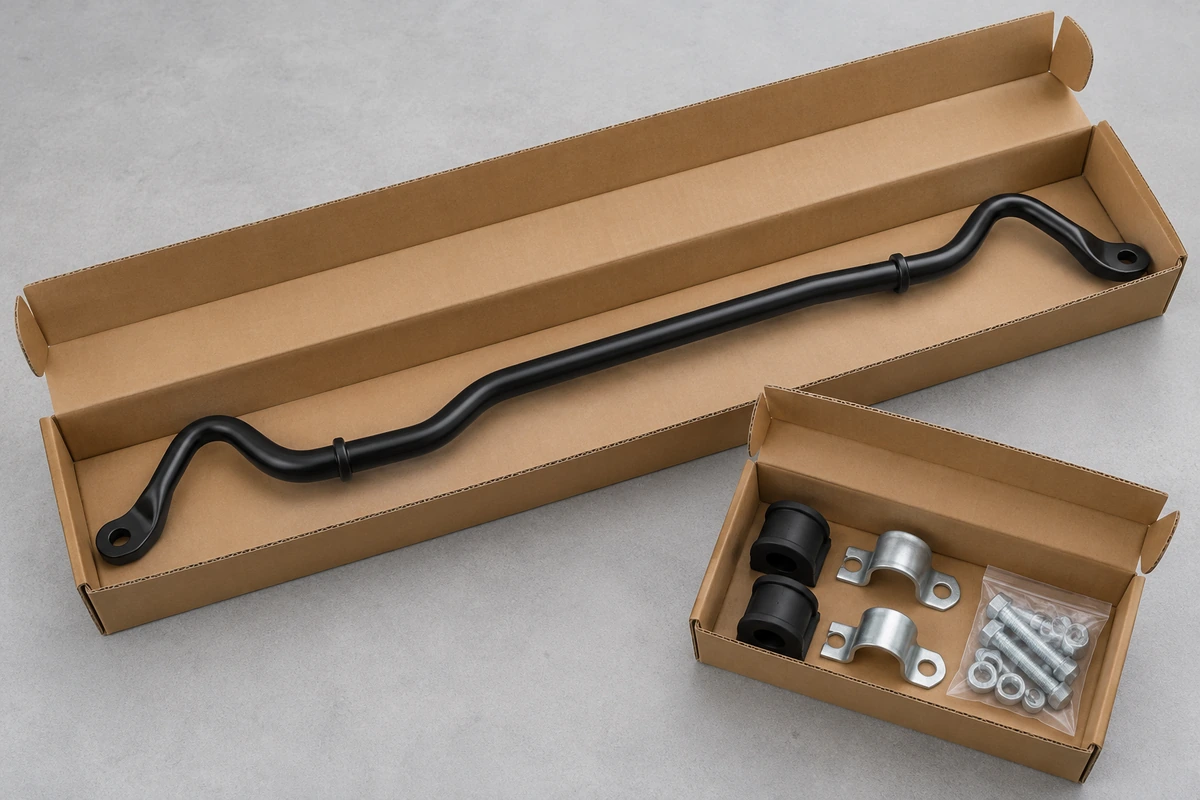
When an anti-roll bar kit is proposed as a long carton plus a separate fittings pack, the dispatch record needs to preserve one complete purchased set across those physical packages. A shipment can contain every ordered part and still send a workshop an incomplete kit. Review completion by destination before approving the split-carton arrangement.
The bar, application and included fitting groups should already be agreed. This article does not choose suspension components or create a hardware list. It addresses a particular packing change: the long item and its smaller companions no longer travel as one self-evident issue unit.
Confirm what the separate fittings pack belongs to
The febi steering and suspension page identifies anti-roll bar ProKits with mounting items such as bushes, links, nuts, bolts and brackets. Its English range description, checked on 14 October 2026, illustrates that a purchased bar kit can have several associated component groups. It does not establish the contents or carton arrangement of any particular alternative offer. febi Anti-Roll Bar ProKits
Use the actual approved kit schedule to identify the companion groups. The packaging record may refer to one accepted fittings pack when its contents are already controlled elsewhere. If several packs are supplied, preserve each reference. Avoid rewriting an established contents schedule from a promotional picture simply to make the packing sheet shorter.
Keep the kit reference distinct from the bar-only reference. If a provider calls both products by the same informal name, retain the order-line reference that settles the purchased scope. A bar delivered without its ordered fittings should not become a complete bar-only order through a shortened carton description.
Make the destination the completion boundary
Ask where each complete kit is intended to become available: a common receiving warehouse, a specific branch or a named workshop destination in the agreed order. That answer determines whether a shared fittings carton is a proposal the buyer can use.
A common warehouse may have an expressly agreed allocation process. A direct dispatch to two different destinations needs a different record, because a fittings pack sent to destination A cannot complete destination B’s delivery merely by appearing on the master list. Do not assume that the first recipient will forward parts on the buyer’s behalf.
The total physical carton count is another distinct field. Two complete kits may occupy more than two cartons under the proposed arrangement. Counting packages as kits overstates supplied quantity; counting only long cartons omits the companions. The record needs both the commercial kit quantity and the actual package relationships, without prescribing how the packages are physically secured.
Build a destination-linked kit record
Use one kit line per intended complete handover. If the provider combines several fitting groups in one outer carton, its record must still show how each group relates to its approved kit and destination. The worksheet is an original buying aid, not a transport or suspension standard.
| Record field | What the response must identify |
|---|---|
| Purchased kit | Approved bar-kit reference and quantity unit |
| Long-carton reference | Actual carton carrying the corresponding bar |
| Fittings references | Every agreed companion pack for that kit |
| Final kit destination | Destination where the complete ordered unit is due |
| Dispatch grouping | Which physical packages travel in this release |
| Outstanding companion | Missing, deferred or differently routed package and decision owner |
Where one carton contains fittings for several kits, distinguish carton identity from each allocated inner group. A single tracking reference may locate the shared carton without answering which kit its contents complete. Ask the provider to document the intended allocations rather than assuming every fittings bag is interchangeable.
Do not invent carrier identifiers or promise synchronized arrival. Use actual references when supplied and mark pending identifiers honestly. The buyer can assess a planned allocation before dispatch, while the eventual dispatch and receipt records establish what actually moved.
Fictional example: three cartons and two destinations
Suppose fictional kits K-East and K-West each consist of an approved bar and its own specified fitting pack. Their bar cartons are L-East and L-West. A proposed third carton, F-Shared, contains both fitting packs. These are invented references and do not describe febi’s packaging or any real shipment.
The master list accounts for two bars and two fitting packs. The dispatch instruction sends L-East and F-Shared to East, while L-West goes directly to West. East can identify its own complete kit if the inner allocation is documented. West’s planned handover remains incomplete because its fittings are elsewhere.
The buyer asks for a revised destination allocation before calling the plan complete. One proposal might direct each identified fitting pack to its matching destination under an appropriate packing arrangement. Another might route both kits through the common warehouse for an explicitly agreed allocation. Those are commercial alternatives to obtain from the actual provider, not assurances that either is available or suitable for transport.
Now imagine the West fitting pack is a backorder rather than merely misrouted. Correcting a carton reference cannot close that supply gap. The buyer needs a separate decision on whether to authorize a partial dispatch, retain the kit pending completion or accept another provider-proposed arrangement. Any partial release should keep the missing companion visible in both the order and destination records.
This distinguishes a kit-completion decision from a simple tracking query. A transport update may establish where L-West is, but it cannot establish that K-West is complete without the companion information.
Preserve completeness through later dispatch changes
Before release, compare the accepted kit schedule, destination allocation and final package list. If a late carton split changes where the fittings travel, review the affected kit again. The bar’s product reference can remain unchanged while the planned complete handover changes materially.
Photos of accessible package references may support the association record. They do not prove concealed quantities, hardware suitability or suspension performance. Physical protection, permitted handling and technical acceptance belong to the appropriate provider; this article supplies no fitting, torque or packing-construction instructions.
See Suspension parts and how we check an auto-parts supplier. An Autoparts sourcing request should state the purchased kit, proposed package split and complete-handover destination. The form supports 8–1200 characters and up to five PNG, JPEG, WebP or GIF images, at most 10 MiB each and 20 MiB total. Other technical files, including PDF, CAD and ZIP, require a separately agreed, authorized exchange. Named manufacturer examples do not establish branded supply, affiliation, supplier capability or engineering approval.
Frequently asked questions
Can one fittings carton serve several anti-roll bar kits?
It can be considered only against the actual destination and allocation plan. Identify the fitting groups inside it and which approved kit each completes. If kits go directly to different recipients, a shared carton sent to one recipient leaves the others dependent on an additional, expressly agreed transfer.
Does a delivered long carton count as a complete kit?
Only if the approved purchased unit contains everything represented by that delivery. Where separate fittings are part of the order, the long carton accounts for one physical package rather than the complete kit. Keep the bar, companion-package status and commercial quantity unit distinct.
What if the fittings are delayed but the bar can dispatch?
Treat that as a partial-supply decision for the affected kit. Record the missing companion and ask the buyer to decide on the actual provider’s proposal. Authorization to dispatch the bar should not change the order description to complete or imply that the remaining supply has been secured.
Does the febi example show that all anti-roll bar kits use two cartons?
No. It supports only the existence of associated mounting components in its named kit range. The multi-carton examples in this article are hypothetical. The actual supplier must identify the approved contents and proposed package split, with its own evidence and responsibilities.
Sources
Discuss a sourcing request related to this article.Anti-Roll Bar Kits: Keep Long Cartons and Fittings Linked