
Window Regulator RFQ: Motor, Logic and Safety Scope
Clarify regulator-only versus motor-equipped scope, embedded logic, anti-pinch requirements, harnesses and hardware before comparing window assemblies.
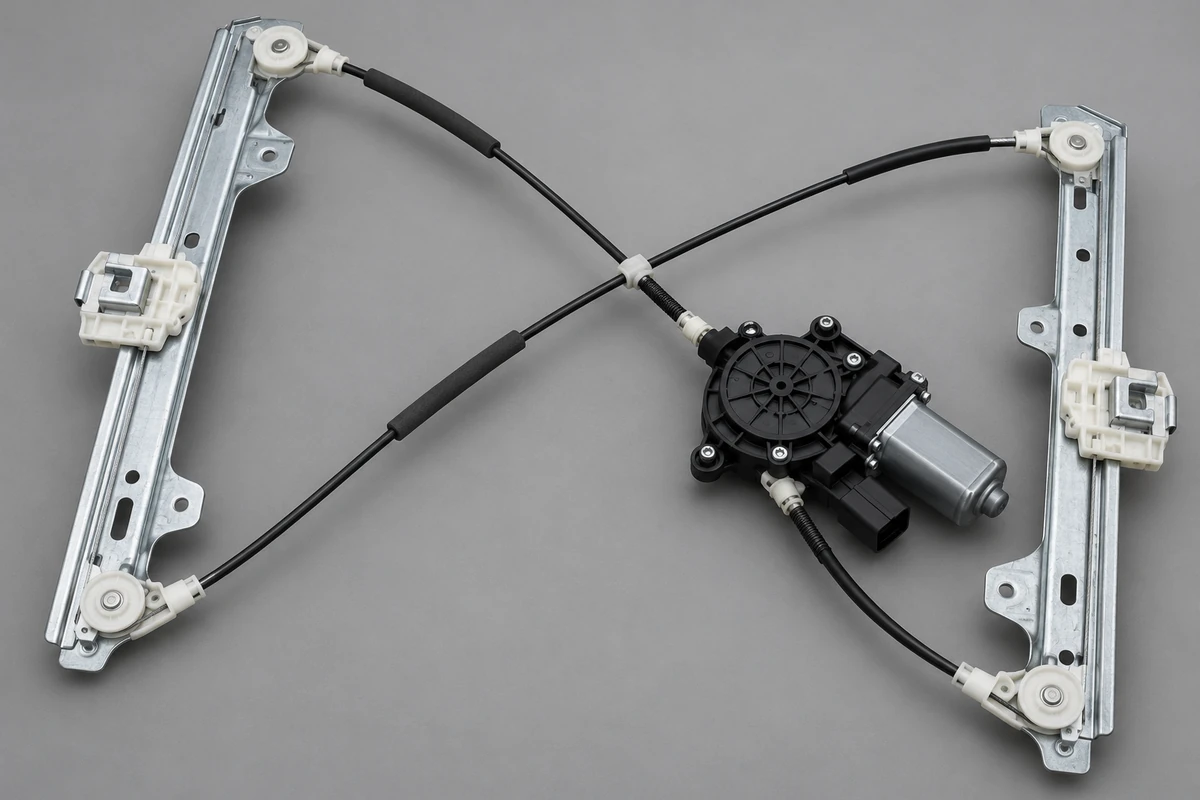
A window regulator described as a complete assembly can still leave the motor, control logic or supplied hardware unclear. Write the RFQ so that the mechanical assembly, included motor and application-specific control requirements are separate answers. A lower price must not rely on an unstated assumption that a retained component is usable.
Start with the authorized door position and application. The replacement scope should already be determined by the responsible person; purchasing should not diagnose the fault from a supplier listing. In particular, a quotation is no authority to remove or bypass a required safety function.
A motor-equipped assembly does not answer every logic question
Dorman’s 741-430 product specifications list a regulator-and-motor assembly and an included wiring harness. The same entry marks the anti-pinch motor and embedded logic fields No, and mounting hardware is not included. These fields describe that named product only. They show why the words “with motor” cannot substitute for an explicit control and safety-feature record. Dorman 741-430 specifications
Do not infer that this configuration is suitable for a vehicle that requires different functions. Nor does a No field in a component catalogue automatically describe every function of the wider vehicle system. Establish where the required function belongs in the actual authorized arrangement and what evidence supports the proposed component within it.
The buyer needs a clear scope answer and a responsible technical decision, not a universal claim that all regulator assemblies should contain identical electronics. If that distinction is unresolved, keep the offer on hold rather than labeling the missing feature harmless.
Draw a purchased-versus-retained boundary
For a regulator-only request, record the authorized basis for that scope and identify any retained motor or control assumption. Do not let the supplier make the retention decision by omitting the motor from a cheap quote. For a motor-equipped request, list the motor inclusion explicitly, then ask separately about logic and the required safety-function interface.
Ask whether the quoted harness is supplied with the assembly and identify its reference where necessary. Keep hardware exclusions visible even when they are commercially small. The phrase “all included” is not enough if the reply elsewhere says that mounting items are additional.
A drawing-based proposal must retain the same discipline. A mechanical outline can describe a regulator’s geometry without establishing its control behavior. If a custom proposal addresses only the mechanical component, state that limitation. Do not allow a dimensioned drawing to become implied approval of an entire powered window system.
A regulator-scope worksheet
| Boundary | Record the requirement | Keep this question open until answered |
|---|---|---|
| Door/application | Authorized position and variant | Does evidence identify this offered assembly? |
| Mechanical regulator | Required supplied object | Regulator only or broader assembly? |
| Motor | Included or outside scope on an authorized basis | Is retained-motor usability merely assumed? |
| Logic | Application-specific requirement and location | What electronics does the offer actually contain? |
| Safety function | Required function and responsible reviewer | Does the proposed arrangement preserve the requirement? |
| Harness/hardware | Each needed supplied item | Which pieces are excluded from the price? |
Use distinct rows for component inclusion and system acceptance. A seller can answer “motor included” fully while the safety-function question remains unresolved. Marking both rows green from one answer would erase the decision that matters.
Fictional comparison: complete mechanically, unresolved functionally
A fictional buyer’s approved request calls for a regulator-and-motor assembly for a specified door, with a defined control and safety-function requirement. Offer A is regulator-only. Offer B includes the motor and harness but says nothing about the required logic or safety-function scope. Neither is an actual quote or an accepted replacement.
A changes the purchased object. The buyer asks for the required motor-equipped configuration instead of assuming the old motor can be reused. B answers more of the contents list, but its silence is not evidence that the remaining requirements are met. Ask for the actual assembly’s control-scope information and the required application-specific support.
If B replies that a required function is absent, leave the proposal unapproved for this baseline. Do not convert the clarification into a bypass, adaptation or powered-cycling procedure. If a qualified reviewer identifies a supported arrangement in which the function is provided elsewhere, that conclusion must be documented for the actual application; the buyer cannot invent it to preserve B’s price.
Both suppliers may still provide useful information. The disciplined response is to narrow the unanswered questions, not label one supplier dishonest or the other accepted because its box contains more pieces.
Keep negotiation away from unresolved safety changes
Ask for the actual price of the authorized assembly scope, including each required supplied component. Discuss quantity and ordinary commercial terms only on a clear product basis. If the seller cannot quote that basis, record the limitation rather than presenting a conditional alternative as a matching offer.
A useful final quote identifies the door/application, regulator and motor scope, logic evidence, required safety-function treatment, harness and hardware exclusions. The responsible technical reviewer owns acceptance. No claimed saving, aftermarket label or visually similar rail arrangement replaces that decision.
Prepare the sourcing request
For the broader product group, see Body parts. If the application is not established, start with the OE and application identification guide before asking for a substitute.
Use the Autoparts sourcing request to describe the required item and the particular question left open above. The form accepts a description of 8–1200 characters and up to five PNG, JPEG, WebP or GIF images, limited to 10 MiB each and 20 MiB total. It does not accept CAD, PDF or ZIP attachments. Authorized drawing images can start a discussion; arrange other technical files separately through an actually agreed, authorized exchange.
Keep requests for independent aftermarket or unbranded alternatives tied to the authorized application or drawing. Supplier negotiation and a drawing-based proposal do not establish engineering acceptance, actual manufacturing capability or guaranteed savings. Named catalogue products in this article are documentary examples, not branded-goods offers or approvals of an unknown alternative.
Frequently asked questions
Does a regulator with motor automatically include embedded logic?
No. Motor inclusion and embedded logic are separate scope questions. Request the actual offered assembly’s information and compare it with the authorized application. Do not infer logic from a complete-assembly label or from the presence of a harness.
Can I choose a regulator-only quote and reuse the existing motor?
That retention decision must come from the authorized replacement scope and responsible technical assessment. A supplier’s omission does not establish that the existing motor is suitable. If the approved request includes a motor, ask for a matching motor-equipped quote.
What should happen when an anti-pinch requirement is unanswered?
Keep the dependent acceptance decision on hold and request application-specific evidence from the responsible source. A blank field is not approval to omit the function. This buying worksheet does not authorize bypassing, adapting or testing a powered window system.
Why list mounting hardware if the regulator is called complete?
Complete is not a reliable contents list. Ask which harness and mounting items are included in the offered SKU and which are excluded. Preserve those answers beside the assembly price so that later optional items do not become assumed inclusions.
Sources
Discuss a sourcing request related to this article.Window Regulator RFQ: Motor, Logic and Safety Scope