
Record MAP Sensor Port and Seal Condition Without Probing
Record MAP/T-MAP identity, external pressure-port condition and supplied-seal damage separately, without pin-count shortcuts, probing or calibration inference.
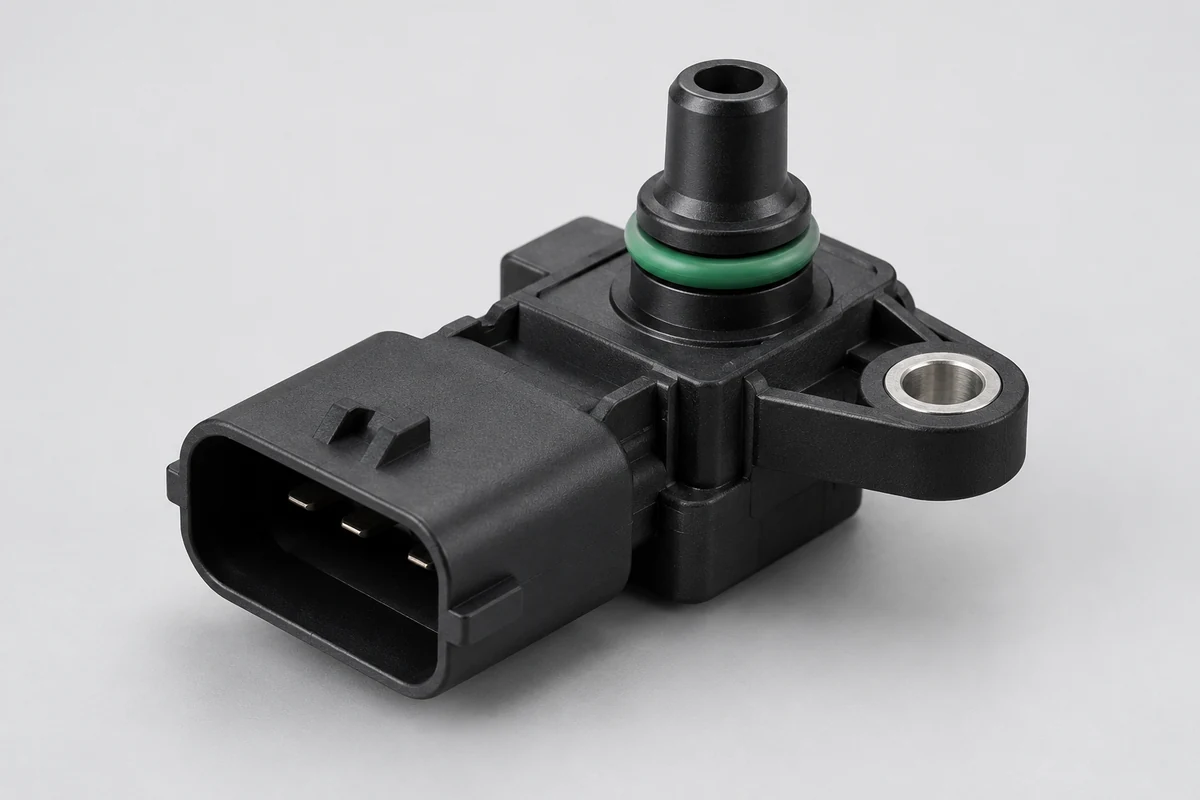
A MAP sensor with a damaged-looking pressure port or torn supplied seal needs a condition record that stays separate from its product identity. If the label is unclear, a familiar connector cannot establish whether the delivered unit is the ordered MAP or T-MAP variant. Resolve both questions without probing the port or testing the pins.
This article concerns already specified, unused sensors. Its receiving outcome is a traceable port/seal observation and a clear identity or evidence gap, not a calibration result or a substitute-selection method.
MAP and T-MAP are not labels to infer from appearance
DENSO describes pressure information being passed to the engine control unit and explains that T-MAP adds an integrated air-temperature sensing function. That is a functional distinction relevant to identity. It does not provide a universal pin-count shortcut for identifying an unknown unit or establish interchangeability. DENSO MAP and T-MAP overview
Keep the order’s exact sensor reference, revision and required function record. Compare it with the delivered marking and applicable supplier documentation. If a character in the marking is unreadable, preserve the uncertainty instead of selecting the nearest familiar catalogue code.
A connector photograph may be useful in documenting the supplied object, but it cannot fill a missing calibration, function or application record. A supplier saying “same connector” leaves the identity question unanswered. Ask for product-specific evidence tied to the actual delivered unit or traceable lot.
Describe the external pressure interface without entering it
Use safe accessible views of the port exterior and surrounding housing. Record a visible chip-like feature, deformation concern, uncertain line or obstructed area in plain terms. Do not insert a probe, apply compressed air or use pressure to decide whether an opening is clear.
The visible port shape and the internal sensing condition are separate subjects. A tidy exterior cannot establish that the pressure response is correct. An unexplained external mark likewise does not provide a complete diagnosis of internal damage. The buyer can preserve a condition hold without pretending to have measured the sensor.
Keep the view tied to a product feature so the supplier can locate the concern. If the port is partly obscured by supplied protection, state the limit rather than removing or modifying that protection merely to complete a photo set. Any further competent examination needs its own agreed scope.
The supplied seal has its own identity and condition
Record whether the specified seal is present and accessible, and describe any visible tear or displacement. Do not assume every sensor has the same seal arrangement, material or dimensions. Use the actual approved supply record to distinguish missing evidence from a missing required item.
A damaged seal and an unclear sensor label create two independent issues. A seller may offer a replacement seal while leaving the sensor identity unresolved. Conversely, a corrected identity document does not repair or classify the original seal concern. Keep each outcome attached to its own issue.
Do not remove, stretch, lubricate or replace the seal as an informal receiving fix. A proposal for seal replacement must identify the correct component and appropriate competent work under an authorized decision. A similarly coloured ring from stock is not an established substitute.
An identity-port-seal worksheet
This original editorial worksheet makes three different evidence tracks visible in one record.
| Record | What to enter | Conclusion that must remain separate |
|---|---|---|
| Approved identity | Exact MAP/T-MAP reference and functional requirement | Application and interchange approval |
| Delivered marking | Legible text, uncertain characters and unit link | Identity cannot be guessed from connector form |
| Port exterior | Accessible condition and original view | Internal response or calibration |
| Supplied seal | Required seal reference and visible condition | Material, dimension or sealing performance |
| Connector consistency | Visible form against applicable product evidence | Electrical pin function without a supported record |
| Evidence gap | Missing identity or calibration-related documentation and owner | No visual pass substitutes for required evidence |
Separate “document not supplied” from “document shows a conflicting product.” The former needs evidence; the latter needs reconciliation of a stated discrepancy. Neither authorizes the receiver to energize the part or improvise an electrical test.
If product-specific technical evidence is supplied later, check its actual variant and traceability before marking the document question complete. A test sheet for a MAP variant cannot silently become evidence for an ordered T-MAP simply because their housings resemble one another.
Fictional counterexample: a pin-count shortcut misses two open issues
A fictional order specifies a T-MAP reference under an approved application record. Unit P-7 arrives with a torn supplied seal and unclear label text. The supplier says its connector has the expected pin count, so the buyer can replace the seal and use it. These identifiers and events are invented.
The buyer records the torn seal and the unresolved identity separately. Pin count does not establish the intended function or calibration variant, and seal replacement is not treated as an automatic warehouse task. The next request asks for exact-unit identity evidence and a product-specific disposition of the supplied seal.
Suppose the supplier then provides a legible product document that confirms the delivered reference but does not address the seal. The identity issue can advance if the responsible reviewer reconciles that evidence with the order. The seal concern remains open, and no statement is made about calibration solely because the code is now clear.
If a replacement sensor is agreed, its own marking, supplied seal and port condition need a fresh arrival record. A replacement should not inherit P-7’s clarified identity by administrative convenience if its actual reference differs.
Finish with three explicit statuses
State what is established about identity, what is observed about port and seal condition, and what technical evidence remains required. This is more useful than one broad sensor-pass checkbox. A resolved label, an undamaged-looking port or a new seal does not independently prove pressure calibration, temperature function, vehicle fit or safe operation.
Keep the buying request tied to the actual part
For category context, see Engine parts; the supplier-check guide covers the earlier supplier review. Independent aftermarket or unbranded sourcing and authorized drawing-based proposals require their own product evidence. The manufacturer cited here is a documentary example, not an affiliation, branded-goods offer or endorsement of another supplier.
Start an Autoparts sourcing request with the exact received reference and the unresolved question. The form accepts an 8–1200-character description and up to five PNG, JPEG, WebP or GIF images, at most 10 MiB each and 20 MiB total. PDF, CAD and ZIP uploads are not supported. Arrange other technical files through a separately agreed, authorized exchange. Buying coordination and supplier negotiation do not establish an owned laboratory, an inspection service, engineering approval or a guaranteed remedy.
Frequently asked questions
Can connector pin count identify MAP versus T-MAP?
Do not use a universal pin-count shortcut. DENSO’s distinction concerns the added temperature-sensing function, and the actual unit needs product-specific identity evidence. A matching-looking connector cannot establish the required function or calibration variant.
Should the pressure port be probed or blown clear?
No probing, compressed air or pressure procedure belongs in this receiving method. Record the accessible external condition and preserve any view limits. Internal assessment requires an appropriate separately authorized technical process.
Does replacing a torn seal resolve the entire sensor receipt?
Not necessarily. Seal condition, product identity and required technical evidence are separate issues. Any proposed seal replacement also needs the correct component and an authorized competent scope; an unclear sensor label remains unresolved afterward.
Can a clean-looking port establish correct calibration?
No. Exterior appearance cannot establish the sensor’s pressure response or temperature function. Keep any required product-specific evidence attached to the correct variant and reviewed by the responsible technical owner, rather than treating a visual observation as a test result.
Sources
Discuss a sourcing request related to this article.Record MAP Sensor Port and Seal Condition Without Probing