
Record a Delivered Alternator Pulley-Offset Discrepancy
Resolve a delivered alternator’s label-versus-pulley-offset conflict with a shared datum, revision evidence and separate terminal-layout questions before installation.
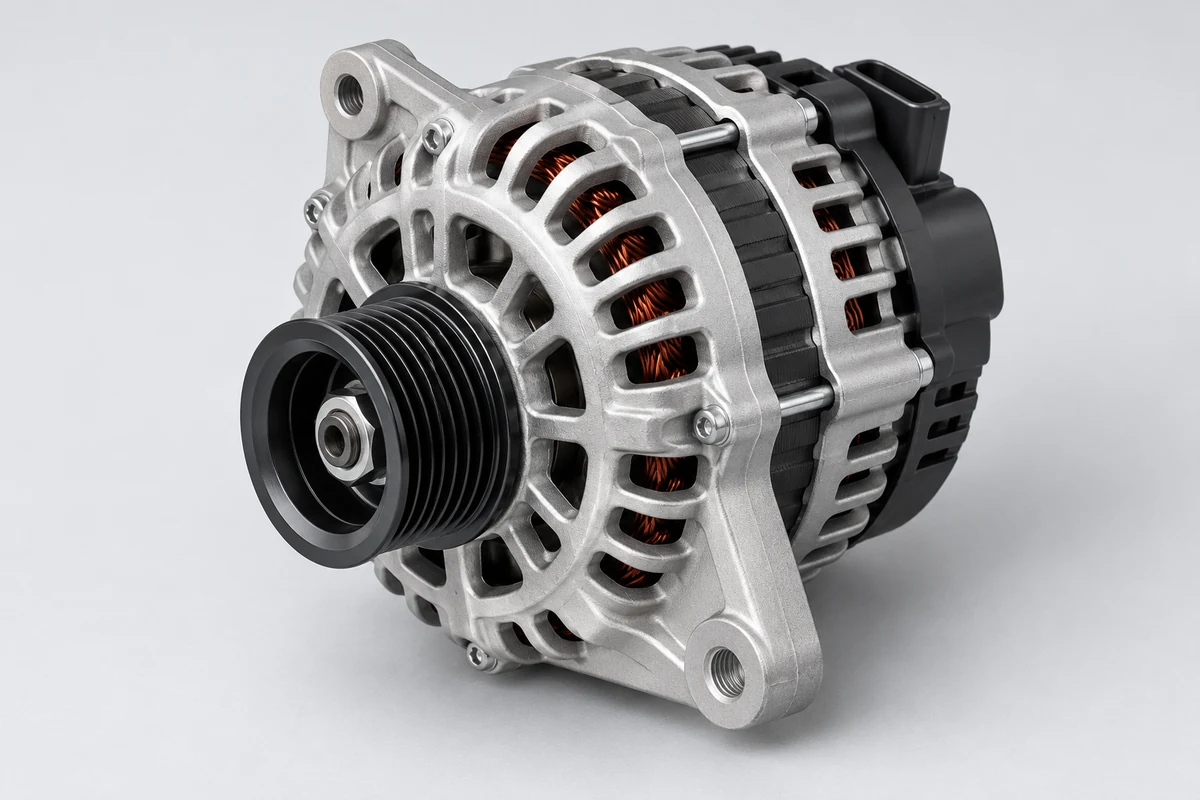
A delivered alternator can carry the ordered reference while its pulley appears to sit differently from the approved drawing. Treat that as an identity-versus-geometry discrepancy to resolve before installation. The matching label is useful evidence, but it is not permission to ignore the observed layout or to swap the pulley until it looks right.
This receiving decision starts with an already approved alternator configuration. It does not select a new pulley type, adjust belt alignment or test charging performance. The buyer needs a controlled comparison and a revision-specific answer about the actual supplied unit.
Fix the reference before measuring the difference
Use the drawing, approved sample record or product-specific reference that governed the order. Record its revision and relevant view. An angled marketplace photo may illustrate a product but is weak evidence for a pulley-offset dispute. Do not replace a controlled reference with a more convenient sales image after the delivery arrives.
DENSO’s replacement guidance names housing and pulley offsets, pulley size and type, mounting-hole locations, connector locations and terminal configuration as comparison subjects. These fields are useful context for separating the receiving discrepancy. The source is not a dimensional standard for an unknown alternator and does not approve vehicle fit from a photograph. DENSO alternator comparison guidance
If the required drawing is unavailable, record that gap before inventing a datum. A receiver can report a visible apparent difference without establishing its magnitude. The next request should ask for the governing feature definition and controlled evidence, not a guessed millimetre allowance.
Describe offset relative to an identified housing feature
A pulley offset concern needs a reference surface or feature to have a shared meaning. Keep the approved drawing’s definition intact and ask the supplier to use that same basis. A measurement from the front of a different housing feature can produce a plausible number while answering a different question.
Record the delivered view and the reference view separately, including their orientations. Perspective can exaggerate or hide a difference. An image annotation may point to a suspected offset, but it should not claim to be a calibrated measurement. Preserve the original images beside any annotations.
Where a controlled assessment is needed, have the responsible technical owner define the feature, method, criterion and competent provider. Record the source of any returned result and which unit it covers. This article does not prescribe a tool setup, tolerance or measurement technique.
Keep pulley type and apparent offset as separate fields. A supplier’s answer that the pulley type is correct does not settle its position. Equally, an apparently matching position does not establish that the supplied pulley type agrees with the order.
Terminal layout cannot be cleared by a pulley answer
Map any visible connector or terminal-layout difference to the actual reference. Avoid labelling a terminal electrically from its appearance if the supporting product record is unclear. A familiar number of terminals is not a compatibility decision.
The mounting-hole record likewise needs the authorized reference, not a vehicle trial. If a hole location appears different, record the concern independently from the pulley. Do not install the alternator, alter a bracket, change the pulley or run a charging/load test to see whether the discrepancy matters.
If the supplier calls the changed layout a new revision, ask for its exact identity, the change description and its applicability to this order. A later revision is not automatically an authorized substitute. Keep a proposed revision decision separate from the condition of the unit that was actually received.
A datum-and-revision discrepancy worksheet
This original worksheet is for a delivered conflict, not a quote feature list.
| Record | Evidence to retain | Question before closing |
|---|---|---|
| Approved revision | Governing drawing or reference and relevant view | Was this the authorized purchase basis? |
| Delivered identity | Actual marking and unit/lot link | Does the supplier explain the geometry under this identity? |
| Housing reference | Exact approved datum or feature definition | Are both comparisons using the same basis? |
| Pulley evidence | Type and apparent position kept separate | Is there a controlled result or only a visual concern? |
| Mounts and terminals | Individual difference locations | Does a reply cover each disputed feature? |
| Revision disposition | Attributable explanation, reviewer and scope | Is a changed configuration approved or still proposed? |
Where no measurement has occurred, write “controlled comparison pending.” Do not enter zero deviation to mean no result. Where a supplier sends a result for another unit, preserve the limited scope rather than describing it as the received unit’s measured value.
Fictional counterexample: a matching label does not waive geometry
A fictional alternator A-4 carries the reference specified in its order. Its pulley appears farther from the documented housing datum than the approved view shows. A terminal location also appears different. The seller replies that the label proves the correct part was sent. These observations and identifiers are invented.
The buyer retains the label as one piece of evidence and keeps the two geometry questions open. The request asks for a comparison on the agreed datum and an explanation of the terminal layout for A-4’s actual revision. It does not accuse the supplier of a wrong product solely from perspective, and it does not accept the product solely from its label.
Suppose the supplier supplies a revised drawing that explains the pulley position but does not establish approval for the order. That is a useful revision proposal, not retrospective acceptance. The responsible owner must resolve whether the change can be considered and what evidence is needed. The terminal concern also remains open if the new document does not address it.
No pulley is exchanged and no belt is fitted to make the delivered unit match the older image. Those actions would alter the object whose supplied configuration is in dispute.
Close the conflict with an attributable configuration decision
A useful outcome identifies the unit, governing revision, compared features and any approved change. It may be a corrected identity, a qualified disposition or an agreed replacement under actual terms. A resolved dimensional record still does not establish electrical output, safety or vehicle suitability by itself.
Keep the buying request tied to the actual part
For category context, see Engine parts; the supplier-check guide covers the earlier supplier review. Independent aftermarket or unbranded sourcing and authorized drawing-based proposals require their own product evidence. The manufacturer cited here is a documentary example, not an affiliation, branded-goods offer or endorsement of another supplier.
Start an Autoparts sourcing request with the exact received reference and the unresolved question. The form accepts an 8–1200-character description and up to five PNG, JPEG, WebP or GIF images, at most 10 MiB each and 20 MiB total. PDF, CAD and ZIP uploads are not supported. Arrange other technical files through a separately agreed, authorized exchange. Buying coordination and supplier negotiation do not establish an owned laboratory, an inspection service, engineering approval or a guaranteed remedy.
Frequently asked questions
Does the ordered part number override a visible pulley difference?
No. Keep the marking and geometry as separate evidence and ask for an explanation tied to the delivered revision. The difference may need a controlled comparison, but the label alone does not waive it or prove the configuration acceptable.
Can offset be measured from a marketplace photograph?
Do not treat a perspective image as a controlled measurement. It can identify an apparent concern, while the actual datum and assessment basis come from authorized product information. Missing measurement evidence should remain explicit.
What if the supplier says the alternator is an improved revision?
Ask for the exact revision, changed features, applicability and authorization for this order. Improvement language is not an approval. A new configuration can be considered only through the appropriate technical and purchasing decision.
Can the receiver swap the pulley to match the drawing?
No pulley swapping, belt adjustment or charging test belongs in this receiving method. Preserve the supplied object and request an exact-unit configuration outcome. A proposed modification is a different activity requiring its own competent scope and authority.
Sources
Discuss a sourcing request related to this article.Record a Delivered Alternator Pulley-Offset Discrepancy