
Push-Rivet RFQ: Resolve Drawing Datums Before Price
Clarify push-rivet head, shaft and length fields against an authorized drawing before requesting a custom trim fastener or comparing supplier offers.
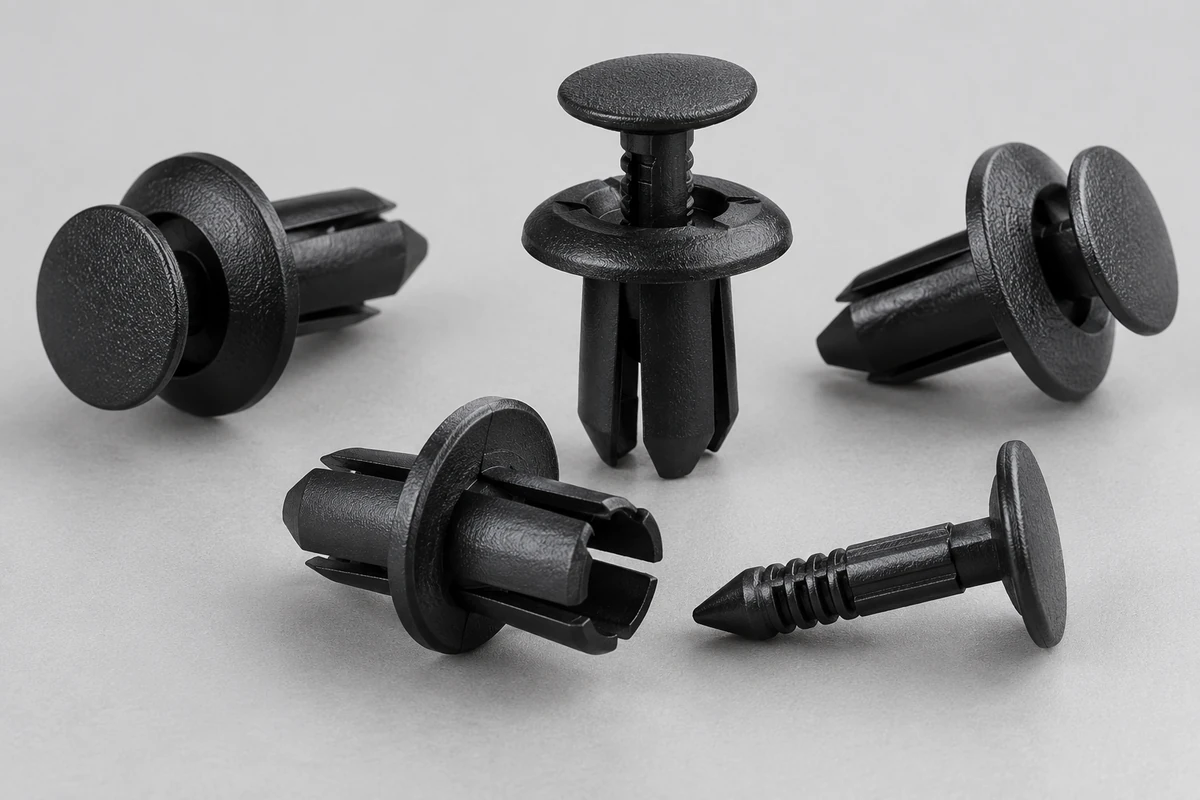
A push-rivet RFQ can fail before material or price is discussed: the buyer and supplier may use “length” or “diameter” for different features. For a custom trim fastener, name the feature and measurement references on an authorized drawing. Do not ask a supplier to manufacture whichever interpretation of a catalogue field is cheapest.
The task is to establish a reviewable dimension record for the actual rivet. It is separate from choosing carton protection, calculating pack multiples or deciding that a visually similar fastener will retain a vehicle panel correctly.
Preserve ambiguous catalogue fields instead of repairing them
Dorman’s 961-359D entry gives Length as 1.32 inches and Overall Length as 1 inch. It also contains shaft-diameter entries of 1/4 inch and 0.3 inch, and lists a package of four rivets. These are the page’s unresolved field differences, not a controlled dimensional specification. Do not select one value, average them or reinterpret one as a tolerance. Dorman 961-359D fields
This example is useful precisely because it cannot safely be converted into a manufacturing drawing from the text alone. The next step is clarification from the responsible source, not a confident conversion to millimetres. Changing units would preserve the disagreement rather than resolve it.
For a real request, retain the original field wording and source beside the question. If a supplier provides a corrected drawing, identify its authority and revision. A later sales message containing a number should not quietly replace an authorized drawing unless the responsible owner accepts that change.
Give the rivet’s features distinct names
Use the actual controlled drawing to distinguish the head or visible face, the shaft, the overall extent and the functional length relevant to the approved application. Identify the surfaces or points used for each dimension. Purchasing should request this definition from the design owner rather than create a new datum scheme from a photograph.
Keep the application hole and panel requirement separate from the rivet’s own measured dimensions. A shaft diameter is not permission to infer the required hole size or panel thickness. Those interface requirements need an authorized source and must remain visible if unknown.
Where a drawing-based alternative is requested, identify the material requirement and who owns it. A broad material family or colour does not establish the required condition, dimensional behavior or retention performance. Ask a supplier proposing a different material to state the change separately, with the evidence the responsible reviewer requires.
Build a feature-to-drawing worksheet
| RFQ field | Controlled reference to enter | Clarification trigger |
|---|---|---|
| Part and drawing | Authorized identity and revision | Seller uses a listing rather than the issued drawing |
| Head/face | Feature name and drawing callout | Diameter names point to different features |
| Shaft | Defined feature and measurement location | Multiple shaft values are unexplained |
| Length | Overall and functional dimensions kept separate | A single length value lacks endpoints |
| Application interface | Authorized hole and panel requirements | Supplier infers them from shaft size |
| Material | Required specification and decision owner | Offer says only black plastic |
| Selling unit | Individual piece count in the price | Pack quantity is mistaken for piece price |
Record an unanswered feature as unresolved rather than zero or not applicable. The worksheet is an original purchasing aid, not a set of dimensions or a retention standard. It should point to the approved definition rather than become a competing drawing.
Fictional comparison: two meanings of “length”
A fictional buyer has authorized a push-rivet drawing that distinguishes total length from a separately defined functional shaft length. Supplier A replies with one “length” value copied from a catalogue and does not identify the endpoints. Supplier B acknowledges the drawing revision and gives separate responses to its two callouts, but proposes a different material. No actual dimensions, suppliers or fit results are represented.
A has not provided a matching dimensional answer. The buyer sends the two drawing callout references and asks A to respond to each. B has clarified the dimensional basis but remains an alternative on material. Its more complete dimension response does not approve the material change or prove retention performance.
If A later confirms that it used overall length where the request called for functional length, retain the discrepancy and obtain a revised proposal. Do not alter the drawing to make A appear compliant. If B cannot supply the baseline material, ask the authorized owner whether its separately documented proposal should even enter further review.
This comparison creates two different next actions: resolve A’s measurement meaning and review B’s declared material deviation. A generic request to “confirm fit” would obscure both.
Price an acknowledged drawing, not a reconstructed catalogue
Ask for a quotation referencing the authorized revision, requested piece count and explicit exceptions. A supplier may propose a custom tool or dimensional change, but request its actual feasibility and commercial response without assuming either capability or savings. Do not add default tolerances merely to obtain a faster quote.
When catalogue and drawing information disagree, identify which authorized source governs and preserve the unresolved evidence until the owner resolves it. The buyer can compare manufacturing proposals only after both sides mean the same features. Technical suitability and required retention evidence remain separate acceptance responsibilities.
Prepare the sourcing request
For the broader product group, see Body parts. If the application is not established, start with the OE and application identification guide before asking for a substitute.
Use the Autoparts sourcing request to describe the required item and the particular question left open above. The form accepts a description of 8–1200 characters and up to five PNG, JPEG, WebP or GIF images, limited to 10 MiB each and 20 MiB total. It does not accept CAD, PDF or ZIP attachments. Authorized drawing images can start a discussion; arrange other technical files separately through an actually agreed, authorized exchange.
Keep requests for independent aftermarket or unbranded alternatives tied to the authorized application or drawing. Supplier negotiation and a drawing-based proposal do not establish engineering acceptance, actual manufacturing capability or guaranteed savings. Named catalogue products in this article are documentary examples, not branded-goods offers or approvals of an unknown alternative.
Frequently asked questions
Which push-rivet length should I use when a catalogue lists two?
Do not choose a value without clarification. Preserve both field names and ask for an authoritative drawing or explanation that identifies the measurement endpoints. A catalogue inconsistency is not a tolerance range and should not be silently reconciled.
Can shaft diameter define the application hole size?
Not by itself. The rivet dimension and the approved hole/panel requirements are different pieces of information. Use the authorized application or design record for the interface and keep it open if it has not been supplied.
What does a supplier need for a drawing-based trim rivet quote?
An authorized part drawing and revision, clearly identified features and dimension references, the applicable material requirement, piece quantity and required evidence. Ask the supplier to acknowledge those documents and declare exceptions; do not create dimensions by scaling a product image.
Does a matching drawing prove a substitute clip will retain the panel?
No. It clarifies what geometry and material are proposed. The responsible reviewer still needs the application-specific acceptance basis and any required performance evidence. A lower price, similar colour or matching headline dimension does not establish retention performance.
Sources
Discuss a sourcing request related to this article.Push-Rivet RFQ: Resolve Drawing Datums Before Price