
Record New Spark Plug Insulator and Electrode Damage
Record ceramic chips and electrode deformation by individual spark plug before adjustment, keeping packaging evidence and technical disposition separate.
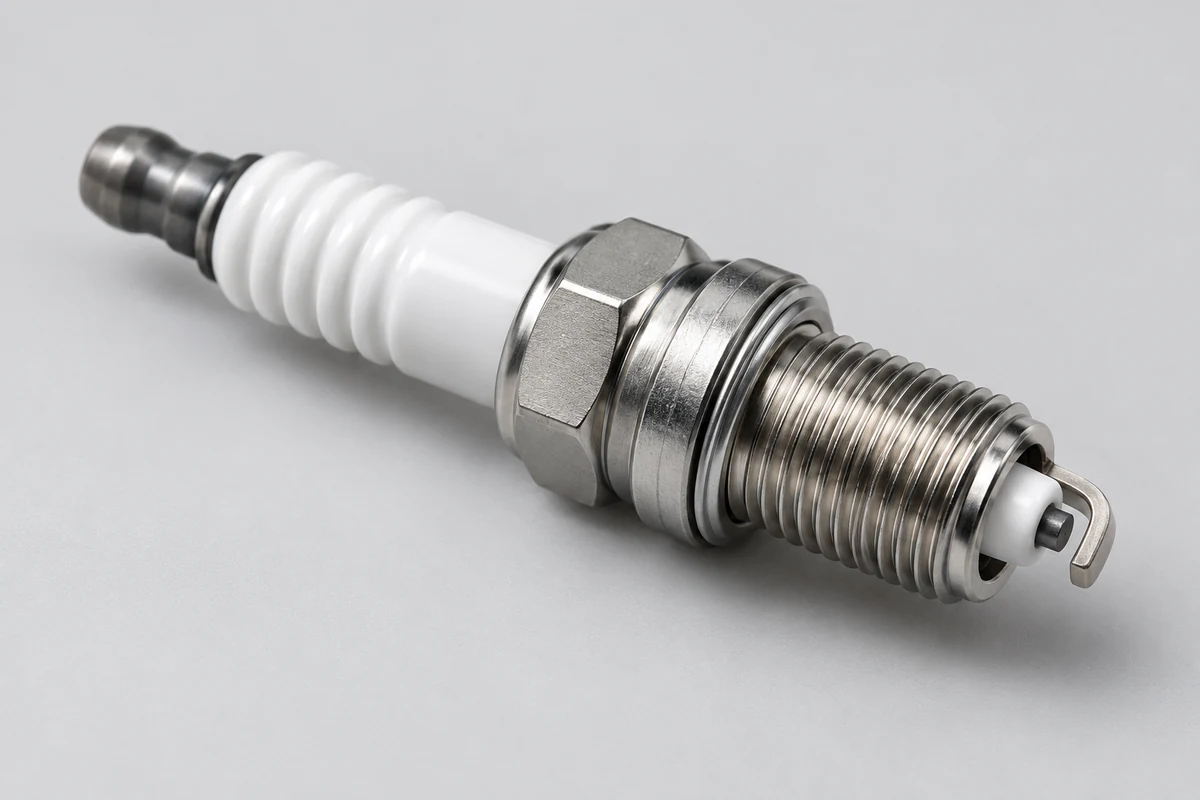
A new spark plug with a chipped ceramic insulator or a visibly deformed electrode belongs in an identified condition hold before anyone adjusts its gap or installs it. The useful receiving decision is which physical plug has which concern. A damaged sleeve, a ceramic chip and an electrode displaced from the expected geometry are three different observations, even when they occur in the same carton.
This article concerns already specified, unused plugs. It does not choose a heat range, establish authenticity or diagnose an engine. DENSO’s current fitment checklist explicitly includes checking a new plug for shipping damage. That supports looking at delivered condition; it does not turn an ordinary visual review into proof of internal integrity. DENSO spark-plug condition checks
Keep the ceramic, electrode and sleeve in separate fields
Identify the individual plug through its supplied marking and original sleeve or compartment. If several identical plugs are unpacked together, the relationship between a crushed sleeve and one particular plug can disappear. Use a receiving reference for an unmarked compartment and explain that it is an administrative identifier, not a manufacturer serial number.
For the ceramic, record the visible location and nature of the concern: a missing fragment, a line whose nature is uncertain, or an area hidden by packaging. Do not call an unexplained line a harmless moulding feature or an internal crack on the strength of one view. The useful record preserves the uncertainty for someone qualified to classify it.
For the electrode, describe the observed orientation relative to the documented design. Different approved plug designs can have different electrode arrangements, so another plug selected from a stock drawer is not a controlling reference. Record the actual product code and reference image or drawing used. A view can show an apparent bend without establishing a measured gap or supplying an adjustment instruction.
The metal seat and accessible threads deserve their own observation if an anomaly is already visible. A mark here is not the same issue as damage to the ceramic. Do not screw the plug into a head, fixture or nut to decide whether the threads are acceptable. Receiving should preserve the supplied state, rather than create an installation history that complicates the original question.
A gap-setting request can erase the arrival question
A seller may answer an electrode concern by saying that the gap can be set later. That response does not establish whether the delivered electrode has been bent, whether the offered design matches the order, or what disposition is appropriate for the identified unit. Retain the seller’s response, then return to those questions.
Do not straighten the electrode, insert a tool to make the photo clearer, scrape the ceramic or run an ignition demonstration. If qualified assessment needs a method beyond ordinary accessible observation, the responsible technical owner should define it for the actual product. The existence of an installation procedure elsewhere is not permission to apply it as a warehouse acceptance test.
A crushed sleeve with no visible plug anomaly also remains a limited finding. It is evidence about protection, not automatic proof that the plug is damaged or intact internally. Conversely, intact packaging does not overrule a visible ceramic chip. Keep the observed product condition primary and the packaging relationship as context.
Use a plug-and-location worksheet
This original worksheet records the evidence for a condition decision. It provides no gap value, chip-size tolerance, sample size or lot-release rule.
| Field | Entry to preserve | Question left for disposition |
|---|---|---|
| Plug and sleeve identity | Ordered reference, actual marking, sleeve or compartment link | Does this record describe the particular delivered plug? |
| Ceramic location | Visible chip or uncertain line, with original image ID | Is further qualified assessment needed? |
| Electrode geometry | Apparent displacement and exact design reference | Is this intended geometry or a delivered departure? |
| Seat and threads | Accessible observation, or not viewed | What product-specific assessment is authorized? |
| Handling history | Arrival view and any action already performed | Is the evidence still as received? |
| Unit-specific outcome | Hold reason, response reference and decision owner | Which concern has actually been resolved? |
Write “not viewed” when a surface cannot be observed within the agreed handling scope. Do not substitute “good” for a blank field. Multiple close-ups of one plug also should not become evidence that several plugs were examined.
Fictional counterexample: two damaged-looking plugs, two questions
Imagine an invented delivery of twelve individually sleeved plugs, identified P-01 through P-12 for the record. P-03 has a visible chip in its ceramic, while P-08 has an electrode that appears bent against the approved reference. These identifiers and events are fictional, not a customer case.
The receiver holds P-03 and P-08 separately and records their different concerns. A seller offers to replace P-03 but suggests straightening P-08. The first offer can be considered under the agreed remedy terms; it does not settle P-08. The buyer asks for an attributable technical disposition of P-08 in its unchanged arrival state instead of accepting an adjustment as documentary clarification.
The other ten plugs retain their actual observation status. They are not electrically or mechanically approved merely because two concerns have been isolated, and the two held plugs are still present rather than missing. No defect rate or whole-lot conclusion follows from this example.
Close each concern against the supplied unit
A useful response identifies the plug, explains whether the available evidence resolves the ceramic or electrode concern, and states the next authorized step. A replacement needs its own arrival record. A general assurance about the product range does not answer either identified unit, and a commercial credit does not itself permit use of a damaged plug.
Keep the buying request tied to the actual part
For category context, see Engine parts; the supplier-check guide covers the earlier supplier review. Independent aftermarket or unbranded sourcing and authorized drawing-based proposals require their own product evidence. The manufacturer cited here is a documentary example, not an affiliation, branded-goods offer or endorsement of another supplier.
Start an Autoparts sourcing request with the exact received reference and the unresolved question. The form accepts an 8–1200-character description and up to five PNG, JPEG, WebP or GIF images, at most 10 MiB each and 20 MiB total. PDF, CAD and ZIP uploads are not supported. Arrange other technical files through a separately agreed, authorized exchange. Buying coordination and supplier negotiation do not establish an owned laboratory, an inspection service, engineering approval or a guaranteed remedy.
Frequently asked questions
Can a bent-looking electrode simply be adjusted at receipt?
Do not use adjustment to close an arrival discrepancy. Preserve the original geometry and ask for a product-specific disposition. A gap-setting suggestion leaves the cause, supplied condition and possible damage unanswered; any later technical work needs its own authorized scope.
Does a crushed sleeve mean the plug inside must be rejected?
The sleeve and plug observations should be recorded separately. Packaging damage warrants clarification under the agreed receiving process, but it does not by itself classify the plug. Equally, an intact sleeve cannot cancel a visible chip on the actual ceramic.
What if the ceramic line is too unclear to classify?
Record the line and its location as unresolved, with the original accessible view. Do not scrape or touch it to force a conclusion. The technical owner can decide whether a qualified assessment or another agreed disposition is needed.
Can the rest of the plugs be marked passed after the affected units are isolated?
Only the actual authorized checks and decisions can support their individual status. No visible anomaly is a narrower statement than internal integrity, ignition performance or vehicle suitability. Unexamined plugs should remain explicitly unexamined.
Sources
Discuss a sourcing request related to this article.Record New Spark Plug Insulator and Electrode Damage