
Transmission Kits: Link Optional Oil Cartons to the Ordered Configuration
Keep transmission kit oil cartons tied to the selected with-oil order line, while distinguishing hardware variants, delivered quantities and service fill requirements.
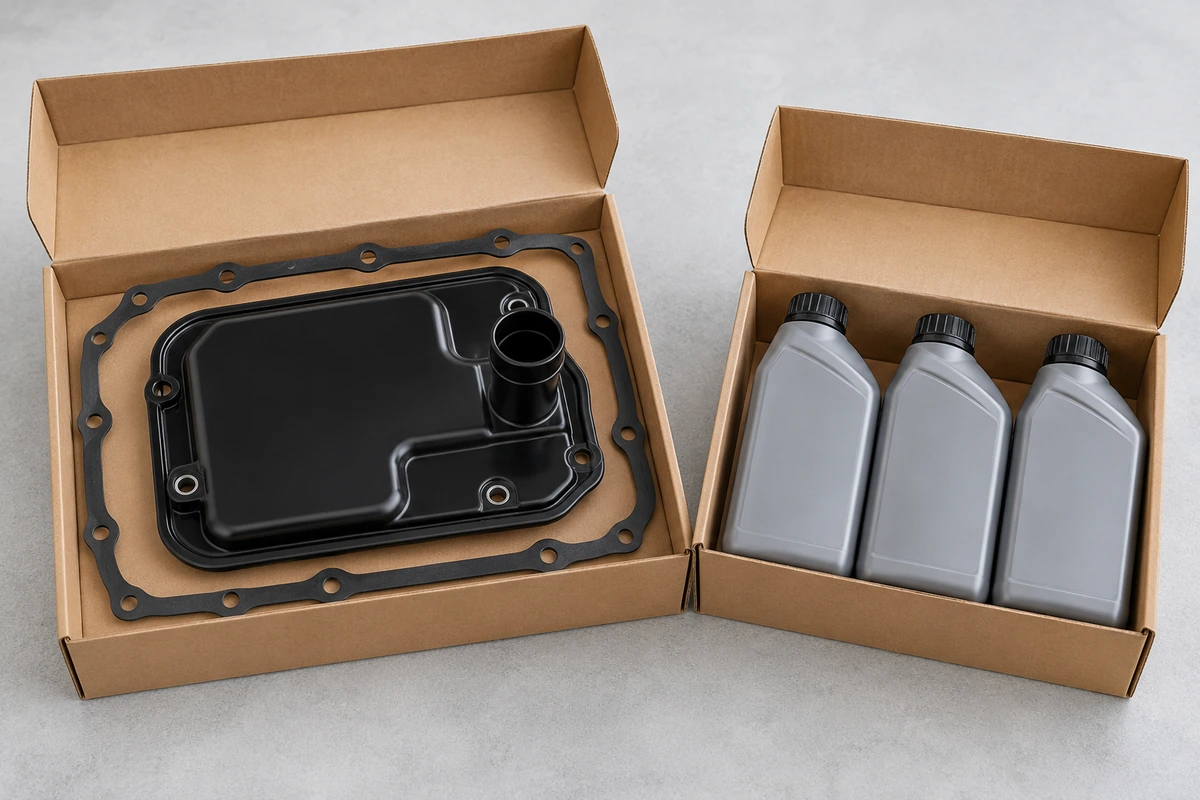
A transmission kit ordered with oil may arrive in a hardware carton and a separate oil carton. A kit ordered without oil may use a similar-looking hardware package. Before approving a mixed dispatch, link each oil delivery unit to the configuration that actually purchased it. Presence somewhere in the shipment does not establish delivery against the right order line.
Begin after the transmission application, hardware configuration and fluid identity have been approved. This review reconciles commercial supply across packages. It does not choose oil, define a service fill amount, classify a shipment for transport or provide transmission-service instructions.
Read hardware variant and oil selection as separate fields
ZF’s global English oil-change-kit page distinguishes with-oil and without-oil offers. Its 6HP and 8HP descriptions also distinguish hardware variants using a separate filter or an integrated plastic pan/filter, depending on transmission type. Checked on 14 October 2026, those examples establish two different scope questions; they do not define another supplier’s kit or a vehicle’s fill requirement. ZF oil and oil-change kits
For the actual order, retain both answers from the accepted configuration. The pan/filter variant identifies the purchased hardware. With-oil status identifies whether an approved fluid supply is included on that order line. Neither answer can be safely reconstructed from a carton photograph or the generic phrase oil-change kit.
Optional describes a choice before the configuration is ordered. Once the accepted line includes the oil, its delivery is part of that line’s agreed scope. The packing team should not treat it as expendable simply because the catalogue also offers a without-oil version.
Keep the oil delivery unit attributable
Ask the provider to identify the separate oil carton and the order line it serves. Where a carton contains supplies for several ordered kits, obtain the allocation by exact fluid identity and agreed delivery quantity. A single carton reference should not be copied against several kits as though each receives the entire contents.
The quantity basis should use the actual ordered units. Record whether the accepted supply is described by bottle count, labeled container size or another specified commercial unit, and keep those fields legible. A count without its size basis can hide a change in the delivered supply. This article does not authorize decanting, repackaging or replacement of one container format with another.
Keep independently purchased stock separate from kit allocations. An extra oil order in the same shipment does not automatically cover a missing kit supply. Any reassignment needs the buyer’s explicit commercial decision and the responsible technical confirmation where product identity is at issue.
Supplied quantity is not required fill quantity
An invoice can establish how much fluid was purchased and a packing record can state how much is allocated for dispatch. Neither document, by itself, establishes how much a specific vehicle or service operation requires. Preserve that distinction in both the order description and any recipient-facing wording.
Do not use a manufacturer’s example bottle quantity to fill a blank in the actual order. Ask the provider to confirm the agreed commercial amount for that configuration. If a message changes from bottles supplied to enough for the job, ask what exact commitment is intended rather than converting the statement into a service recommendation.
The actual fluid’s technical suitability and any required transport information remain separate responsibilities. A clear oil-carton link does not establish either one, and this article supplies no substitution, filling, flushing or hybrid-service guidance.
Use an oil-allocation record
The following editorial worksheet makes the two configuration decisions and the physical dispatch link visible without recreating a service specification.
| Field | Answer needed |
|---|---|
| Kit order line | Exact accepted configuration and quantity |
| Hardware variant | Agreed pan/filter or other hardware reference |
| Oil inclusion | With oil, without oil or an unresolved order discrepancy |
| Approved fluid supply | Actual fluid identity and commercial quantity basis |
| Separate oil package | Carton reference and quantity allocated to this line |
| Complete-handover destination | Where this hardware and its ordered oil are due |
| Outstanding supply | Missing allocation or backorder and decision owner |
Review an oil carton from both directions: which order lines consume its stated supply, and which carton accounts for each with-oil line? An unallocated amount may belong to stock, another kit or an unresolved entry. The provider’s actual records should settle its role; the buyer should not infer it from the remaining arithmetic.
Fictional example: fewer bottles with an unstated size
Assume a fictional with-oil order W includes an already approved fluid supplied as six sealed one-liter bottles. A separate without-oil order D uses its own approved hardware configuration. These invented commercial quantities do not describe a ZF SKU or a service fill requirement.
The packing proposal describes W’s separate oil carton as three bottles but gives no container size. The hardware line still matches W. The buyer cannot tell whether the response describes a shortage, a different container format or a clerical error. Ask the provider to identify the actual container product, labeled size and quantity against W’s accepted supply.
Suppose the provider clarifies that it proposes three two-liter containers of the same approved fluid. The nominal commercial volume is still six liters, but the container format and unit count have changed. Ask whether the proposed sealed supply actually exists, which provider record establishes its identity and whether the buyer accepts the changed commercial units. Equal volume alone does not authorize the change or establish packaging suitability. No transfer or repackaging of fluid is proposed by this example.
Alternatively, suppose the three bottles are still one liter each. The proposal then accounts for only part of W’s agreed commercial supply. It cannot be made complete by copying D’s without-oil description onto W or by calling oil optional across the range. W’s selected configuration remains the relevant baseline until an explicit agreement changes it.
The useful response is therefore about identified supply units: the unchanged six-bottle supply, a separately approved changed-format proposal, or a clearly recorded outstanding quantity. None of those answers establishes how much fluid a vehicle needs. Any wording that says enough for the job remains a separate unsupported service claim unless resolved by the appropriate technical source and owner.
Close commercial completeness on the actual proposal
The final record should show the ordered oil selection, hardware reference, allocated delivery quantity, package reference and destination. If any of these changes, review the affected line before reusing the earlier approval. Complete in this record means accounted for against the agreed supply scope; it is not a statement that a transmission is ready for service.
See Engine parts and how we check an auto-parts supplier. In an Autoparts sourcing request, state the kit’s with-oil status and the unresolved carton allocation. The form accepts 8–1200 characters and up to five PNG, JPEG, WebP or GIF images, no more than 10 MiB each and 20 MiB combined. PDF, CAD and ZIP files require a separately agreed, authorized exchange. The ZF example establishes no affiliation, branded offer, supplier capability or approval of another fluid or kit.
Frequently asked questions
Does an oil-change kit always include oil?
Use the exact accepted configuration. A product family can offer both with-oil and without-oil versions, and a hardware carton may not reveal that choice. Record the purchased inclusion status separately from the pan/filter variant before allocating any oil carton.
Can one oil carton be linked to several kits?
Yes, as a proposal with explicit allocations: identify the actual fluid and quantity assigned to each with-oil line. Do not count the full carton repeatedly. The provider must also explain how those allocations reach the intended complete-handover destinations under the agreed arrangement.
Does the number of bottles supplied define the transmission fill amount?
No. It records commercial supply in the stated container units. The amount required for a specific transmission and service operation needs its own applicable technical source and qualified decision. Do not convert a catalogue bottle example or a packing-list total into filling guidance.
Can fewer, larger containers count as the same oil supply?
Compare the actual approved fluid identity, labeled container size and count. Equal nominal volume may still represent a changed commercial format that needs the buyer’s agreement and provider evidence. Do not assume the format exists, authorize repackaging or treat the delivered volume as a service fill requirement.
Sources
Discuss a sourcing request related to this article.Transmission Kits: Link Optional Oil Cartons to the Ordered Configuration