
Preserve the map inside a drain-plug assortment
Keep compartment locations separate from documented plug-to-ring associations when resizing an assortment, so a new map does not invent pairings or erase independent stock roles.
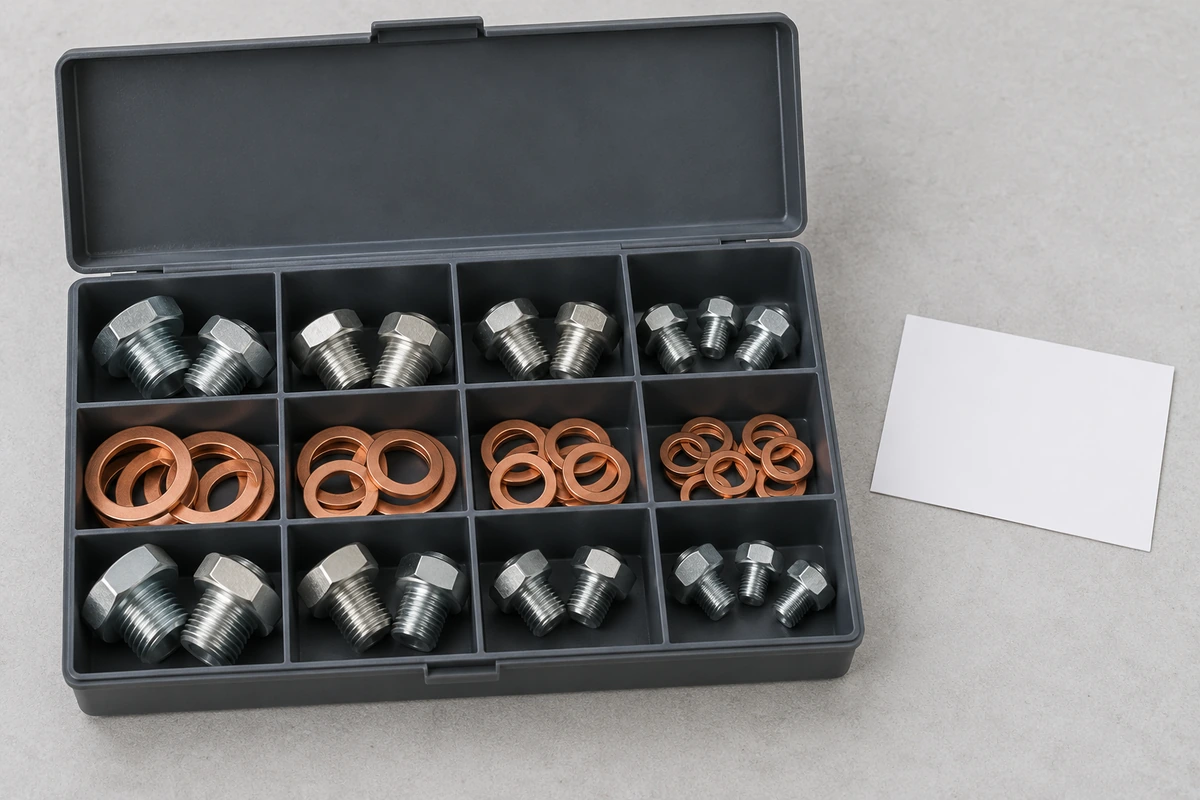
A drain-plug assortment map can describe two different relationships: where an identified item is stored, and which sealing-ring group is supplied with a particular plug group. Keep those meanings separate when the box is resized. Moving a ring compartment beside a plug compartment should not create a new pairing, and moving an agreed companion group away should not erase its existing association.
This decision starts with the purchased plug and ring references already approved. It asks whether a revised compartment map preserves the actual supplied relationships. It does not select a seal material, infer thread fit or decide which ring a vehicle repair requires.
Find out what each ring entry means
Elring’s assortments page, checked on 14 October 2026, presents application-specific sealing assortments and lists oil-drain-plug assortments. One listed reference has inconsistent labels on the page. The source is therefore used only as general assortment context; no part-number, compartment-content or plug-to-ring pairing claim is taken from it.
For the actual assortment, ask the provider whether a ring entry is an identified companion within an approved supplied group or independently identified ring stock. These roles need different map entries. An independent stock reference may have its own approved identity while no plug association is part of this purchase record.
Do not fill that gap with proximity. Rings beside a plug in a photograph may be separate assortment contents, a documented supplied group or merely a presentation choice. Obtain the actual provider’s explanation before a new lid diagram turns the arrangement into an implied selection rule.
Use separate fields for location and supplied association
Give each plug and ring group its own attributable reference and proposed compartment location. Then record any provider-established association in a separate field, with its evidence. A location such as C2 tells the recipient where a group is meant to be found. It should not become the only explanation of which other item it accompanies.
This separation becomes important when the original arrangement uses adjacent compartments. If the approved plug group and its companion rings move apart, both locations can change while their documented relationship remains. If independently supplied ring stock moves next to a plug group, its location changes without creating a new relationship.
A new map should make those two outcomes distinguishable. Ask the provider how its legend differentiates a storage location from an actual supplied-group association. This is a request to clarify meaning, not an instruction to design labels, select seals or choose a physical divider arrangement.
Review what the new map claims, not just where it points
A line joining two compartments, a common heading or wording such as matching ring can introduce a claim that was absent from the accepted assortment. Ask which approved provider record supports that relationship. An accurate drawing of the new box does not supply product authority for an added claim.
The opposite omission also matters. A revised list that moves all sealing rings under one stock heading may lose an established association that the buyer expected to retain. The rings can remain individually identifiable yet no longer be described as the companions supplied with their approved plug group. The map needs to preserve the purchased role as well as the part reference.
Where a supplier proposes changing that role, show it as a separate scope decision. The packer should not reclassify a companion ring as freely interchangeable stock, or independent stock as a plug-specific set, merely to simplify the diagram. Keep technical application approval distinct from the commercial grouping recorded here.
Fictional example: a tidier map invents one pairing and loses another
Imagine a fictional approved assortment containing plug group P-A with its documented companion ring group R-A. It also contains plug group P-B and independently identified ring stock R-B, for which this order record establishes no plug pairing. These references are invented; they specify no real thread, material, dimensions or vehicle application.
A smaller-box proposal moves R-A into a general rings location and places R-B beside P-B. The proposed lid card drops the P-A/R-A association and labels the neighboring P-B/R-B locations as a matching pair. Every group retains a readable reference and the quantity list is unchanged. Identity and counting alone therefore miss both changes.
The buyer asks the provider to restore the documented P-A/R-A supplied-group relationship and to remove or separately substantiate the newly asserted P-B/R-B relationship. It does not ask the packer to choose a ring for P-B. The question is whether the packaging description still represents the already accepted purchase.
Suppose the revised map names both R-A and R-B clearly but still calls all rings interchangeable. The location information has improved while the unsupported relationship remains. Ask for a response to that specific wording rather than accepting a clearer drawing as a complete resolution.
If actual groups have already been mixed and their identities are no longer supported, a corrected relationship map cannot identify them retrospectively. Refer that separate uncertainty to the provider. Do not sort by sight, assume material from color or use a trial fit to reconstruct the arrangement.
Close a relationship-aware compartment record
Use one record per affected plug or ring group, naming the approved assortment revision, attributable part reference, original and proposed location, role as companion group or independent stock, evidence for any association, and the wording changed by the new map. Keep missing identity evidence separate from missing relationship evidence.
The final record should let a recipient locate each identified group without treating a storage cue as a new compatibility claim. If the box or legend changes again, review both the locations and the relationships expressed. This original editorial method does not prescribe packaging construction or certify fit, seal material, product condition or engineering suitability.
Bring the actual proposal into the sourcing request
See Engine parts for category context and the supplier-check guide for the earlier supplier review. The manufacturer example above does not establish affiliation, a branded-goods offer or another supplier’s capability. Independent aftermarket or unbranded proposals need their own attributable evidence.
An Autoparts sourcing request can identify the approved product and the specific packing change still awaiting an answer. The form accepts an 8–1200-character description and up to five PNG, JPEG, WebP or GIF images, at most 10 MiB each and 20 MiB total. It does not accept PDF, CAD or ZIP files; arrange other technical files through a separately agreed, authorized exchange. Buying coordination and supplier negotiation do not establish an owned factory or laboratory, specialist packing services or engineering approval.
Frequently asked questions
Does a ring compartment beside a plug compartment establish a matching pair?
No. Proximity is a location fact, not evidence of an approved plug-to-ring relationship. Ask whether the provider identifies a companion group or independent ring stock in the actual assortment. The revised map should preserve that answer without turning neighboring locations into a selection rule.
Can associated plugs and rings occupy separate compartments?
The applicable provider-approved arrangement determines the physical proposal. For the documentary review, retain separate location references and the evidence connecting the approved supplied group. Moving locations should not silently erase an established relationship, and retaining the relationship does not approve the physical packing design.
Why can a correct part list still leave the revised map unacceptable?
The list may preserve every identity and count while the map adds a new matching claim or reclassifies a companion ring as independent stock. Review the role and supported relationships as well as location. A clearer diagram cannot supply evidence for a pairing the actual order never established.
Can a corrected map identify plug and ring groups that were already mixed?
No. A map records intended locations and supported relationships; it cannot retrospectively attribute unidentified pieces. Record the affected groups and ask the provider for a supported disposition. Do not infer thread, seal material or pairing from appearance, remaining quantities or a trial fit.
Sources
Discuss a sourcing request related to this article.Preserve the map inside a drain-plug assortment