
Air Filter Handover: Any Required Airflow Adaptation
Check whether an exact filter replacement has an applicable ECU airflow-baseline task, then preserve its owner and event-specific completion evidence.
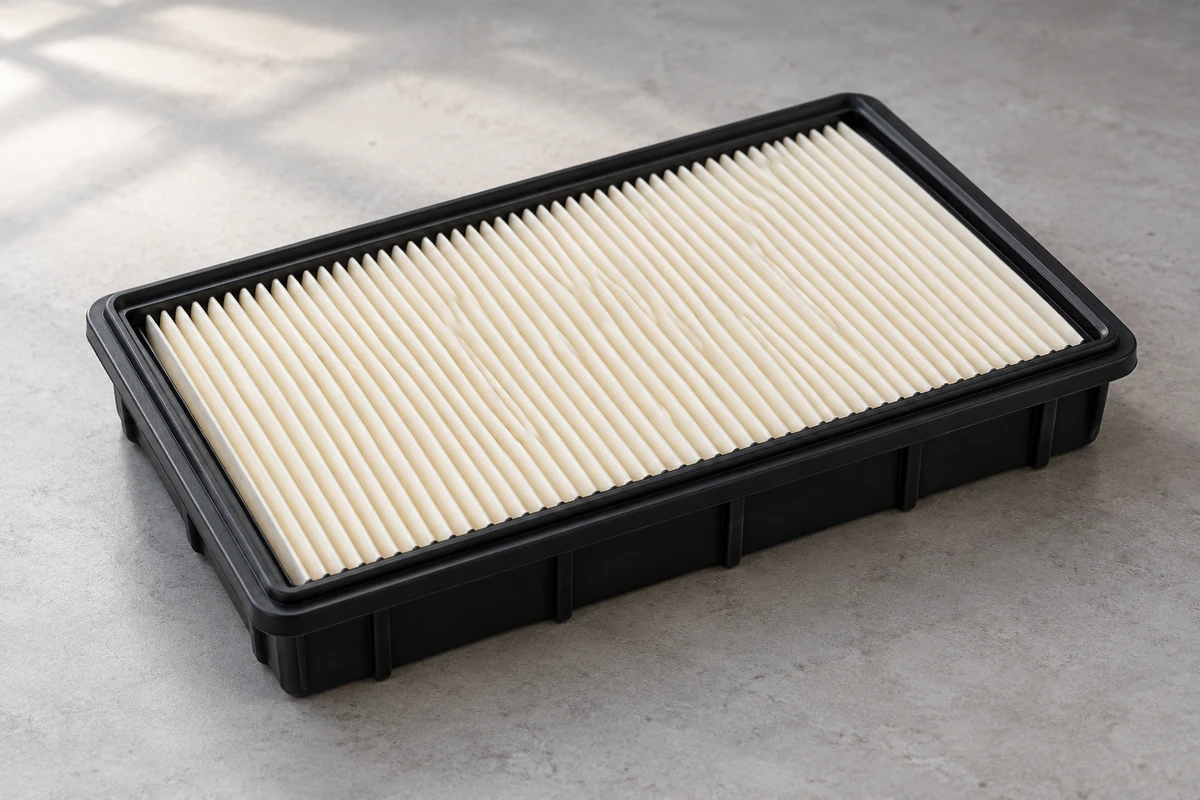
An engine air-filter change may be recorded as a consumable replacement while an application-specific electronic task remains unaddressed. Ask the qualified provider whether the actual vehicle and replacement event require airflow adaptation or another defined ECU task. Do not assume that a tidy filter invoice settles the service scope.
The buyer is preserving a possible dependency, not creating a reset requirement for every filter. The filter selection and supplied condition are already established. This handover provides no diagnostic commands, MAF testing, learned-value changes or fitting instructions.
Keep the Delphi model example narrow
Delphi's diagnostic-jobs article names some diesel Mercedes-Benz applications, including a 2013 Sprinter 2.2L, when discussing an electronic task after air-filter replacement. Checked on 14 October 2026, that example is not current coverage for every Mercedes, diesel engine or filter change. Delphi diagnostic-job examples
The useful question is whether the responsible provider has checked the current requirement for the exact vehicle. Do not turn the historical model example into a universal reset instruction or use it to diagnose an airflow complaint.
Put applicability ahead of a completion checkbox
Retain the established vehicle variant and the actual filter replacement event. Ask the provider to identify the current source used to decide whether an electronic dependency applies. Record the answer as required, not applicable with a basis, or unresolved.
An unmarked box is not evidence of non-applicability. Conversely, the absence of a diagnostic report does not establish that a required task was skipped when the requirement itself has not been determined. The first clarification should address applicability, rather than demanding a generic reset report for every vehicle.
Keep filter condition evidence separate. A correct construction record or a receiving photograph of intact pleats can support the delivered-product review. Neither tells the buyer whether an ECU-related task applies to the service event. The same distinction prevents an electronic completion record from being used to excuse a physical filter discrepancy.
Link the electronic task to the actual change
If the qualified provider identifies a requirement, ask who has accepted that task and which attributable result record will cover it. Preserve the filter-change job reference so the report does not become detached from the event it is meant to document.
A broad service reset entry may refer to another maintenance item. Ask the provider to explain its actual scope rather than renaming it airflow adaptation yourself. A genuine result for an earlier filter change also belongs to a different event, even when the vehicle reference is unchanged.
Where the parts supplier and service provider differ, do not infer a diagnostic commitment from the filter sale. Obtain the actual service scope and terms. The buyer's role is to make the missing assignment visible, not to select a tool or instruct a technician through a menu.
Filter-event applicability worksheet
| Field | Evidence to retain | Decision supported |
|---|---|---|
| Vehicle variant | Actual engine/equipment and market record | Does the source cover this application? |
| Filter change | Established product and replacement-job reference | Which event needs a scope answer? |
| Requirement source | Current instruction and qualified interpretation | Is an electronic task required here? |
| Applicability status | Required, supported non-applicability or unresolved | Is a blank being mistaken for an answer? |
| Assigned provider | Accepted task and expected record | Who owns the dependency if it applies? |
| Completion or exception | Event-linked result and scoped assessment | What remains unconfirmed? |
The worksheet is an original purchasing aid. It does not establish airflow values, adaptation criteria or a universal service schedule.
Fictional case: service reset is too broad
A fictional workshop changes the established filter on vehicle A. Its handover lists filter replaced and service reset, without identifying what the reset covered. The buyer has a product invoice and a completed maintenance line, but no qualified answer about the actual filter-related electronic requirement. All events are invented.
The buyer first asks the workshop to state the current applicability basis. If the provider confirms that no such task applies, retain that scoped answer; do not insist on a reset simply because the Delphi article contains a diesel example. If the provider identifies a required task, ask whether the service-reset entry covers it and request the attributable event record.
Suppose the workshop explains that the existing entry concerns an unrelated maintenance reminder. That is a useful scope clarification, not evidence of filter adaptation. The buyer keeps the applicable task open under its accepted provider and does not edit the old entry to make it appear complete.
If a matching result later arrives, preserve its qualified assessment and limits. It does not establish the condition of the MAF sensor or provide a diagnosis for a separate vehicle complaint.
Leave a precise next-provider record
A good final handover identifies the filter change, the current applicability answer and the status of any required electronic work. Keep a supported non-applicability decision just as traceable as a completed required task. The outcome is an honest service-information record, with technical acceptance and operational decisions left to their responsible owners.
Keep the purchasing enquiry focused
For category context, see Engine parts. In an Autoparts sourcing request, identify the actual part and the unresolved handover question. The form supports an 8–1200-character description or a supported marketplace HTTPS link, and up to five PNG, JPEG, WebP or GIF images, limited to 10 MiB each and 20 MiB combined. PDF, CAD and ZIP files need a separately agreed, authorized exchange.
Independent aftermarket or unbranded buying coordination and supplier negotiation do not establish service-provider capability, fitment, engineering approval or a ready-for-use vehicle. Named manufacturers above are documentary examples, with no affiliation or branded-goods offer implied.
Frequently asked questions
Does every engine air-filter replacement need an ECU reset?
No universal rule follows from the cited example. Ask the qualified provider to check the current requirement for the exact vehicle variant and replacement event. Preserve a supported non-applicability answer instead of demanding a generic reset.
Does service reset mean airflow adaptation was completed?
Not necessarily. Ask what the entry actually covers and whether it maps to an applicable filter-related requirement. A maintenance-reminder reset or another service task should not be relabelled as airflow adaptation by purchasing.
Can a clean filter or intact pleats close the electronic handover?
Those observations concern the supplied filter’s condition. They do not establish whether an electronic task applies or whether it was completed. Keep condition evidence and the event-specific service requirement in separate records.
Does an adaptation record establish that the MAF sensor is healthy?
No such conclusion is supplied by this handover method. Retain the actual report’s scope and qualified assessment. A separate sensor-condition or vehicle-complaint question needs its own applicable evidence and responsible provider.
Sources
Discuss a sourcing request related to this article.Air Filter Handover: Any Required Airflow Adaptation