
Trim-Rivet Reorders: Deduplicate Requests Across OE Aliases
Trace OE-coded trim-rivet requests to unique repair jobs before combining approved references and rounding purchase packs.
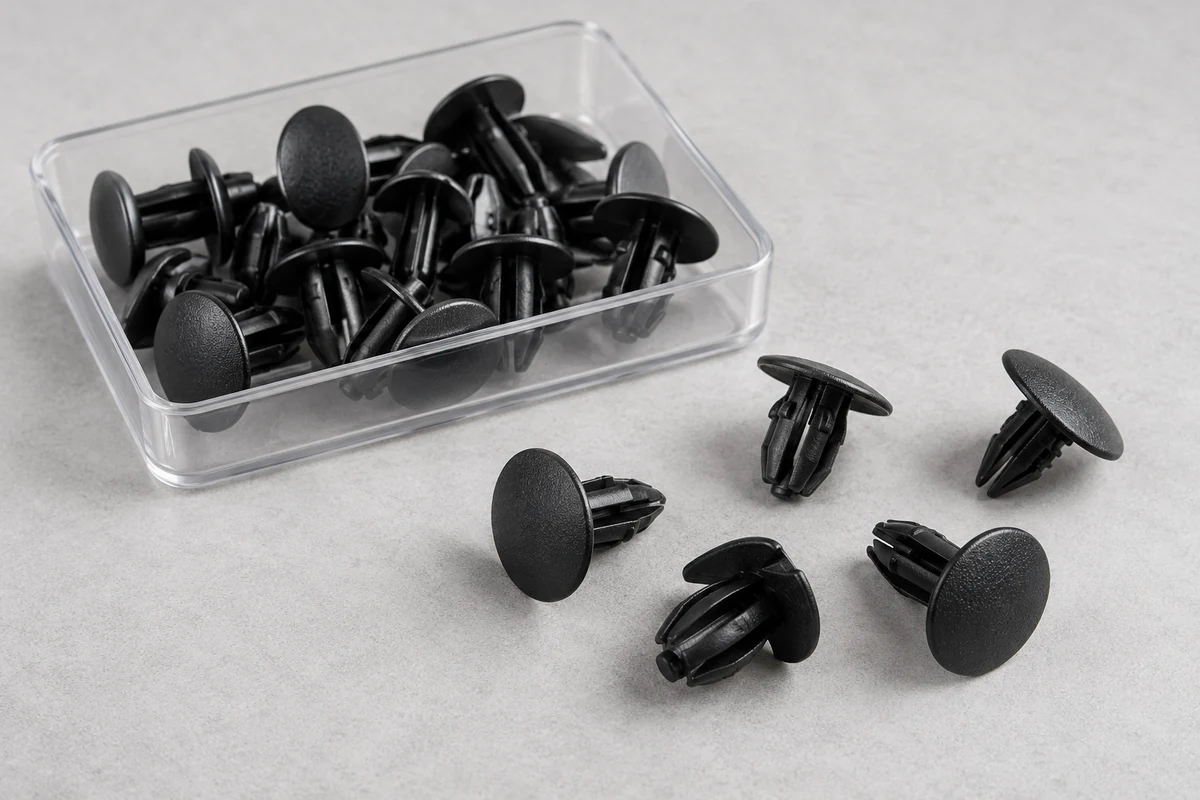
Several OE references can lead buyers toward one approved trim-rivet supply SKU. That does not tell procurement whether the requests describe several repairs or repeated messages about the same repair. Deduplicate demand at the job level before aggregating it under the approved supply reference.
The starting point is an established application and accepted cross-reference. This article does not approve a new rivet from a catalogue, resolve dimensional disagreements or make every listed OE number universally interchangeable.
An alias table is not a job register
Dorman's 961-359D listing includes several direct OE cross references and describes a four-rivet package. Its dimensional fields also contain differences that must not be silently resolved. The page was checked on 14 October 2026. Here it supports only the possibility of several reference names associated with a named supply product and the stated package count. Dorman 961-359D
An OE code answers a product-identification question within its supported scope. It does not identify the vehicle job that generated a request. If two departments use different aliases for one job, summing their requests can double the required pieces. If two different jobs use those aliases, deduplicating by product alone would wrongly remove genuine demand.
Keep the originating job reference and request version beside the OE alias. A later correction may supersede an earlier request rather than add to it. Ask the job owner which quantity is current instead of choosing the larger number as an informal contingency.
Reconcile identity and obligation separately
First confirm that each request already maps to the accepted supply SKU for its actual application. Preserve any qualifications and excluded variants. A seller's broad cross-reference list should not replace the responsible owner's existing decision.
Second, group messages by the unique repair obligation. Distinguish the initial request, an amended count, a purchasing copy and a genuinely additional job. Retain the owner response where two records appear related but have different identifiers.
Only after that reconciliation should the unique piece requirements be added. Apply eligible stock to the combined requirement once, then consider the actual selling pack. Rounding every duplicate message before deduplication can turn one clerical error into several extra packages.
A request-line worksheet
| Field | Decision supported |
|---|---|
| Repair request | Unique job and latest authorized version |
| OE alias | Exact original reference, preserved for traceability |
| Approved supply SKU | Accepted mapping for that job's application |
| Duplicate-request check | Additional obligation, copy, revision or unresolved |
| Required pieces | Current unique quantity before stock coverage |
| Pack rounding | Confirmed selling count and remainder after netting |
Do not overwrite old messages. Mark which one governs and keep the relationship readable. The resulting purchase proposal should be traceable back to the unique jobs, not merely to a spreadsheet total grouped by a product code.
Fictional example: three requests, two repairs
Assume three fictional requests ask for four pieces each. Requests R1 and R2 use different approved aliases but both refer to repair J1; the owner confirms R2 is a purchasing copy of R1. Request R3 belongs to separate repair J2. All identities, jobs and quantities are invented.
The unique requirement is eight pieces, not twelve. With two eligible matching pieces already assigned to this combined demand, six remain uncovered. If the actual offer in this fictional comparison is four pieces per pack, two packs supply eight pieces and leave two beyond the immediate shortage.
The four-piece assumption resembles the named catalogue format but is not proof of a current supplier offer. Confirm the actual offered SKU, package count and order terms. A supplier selling a different bulk unit needs a different conversion.
Now suppose R2 instead belongs to a separately authorized J3. All twelve pieces are real demand, even if every request maps to the same SKU. Product consolidation is still useful for one purchase line, but demand deduplication is no longer justified. The job evidence changes the answer.
Close with a traceable combined request
Record the unique repair count, total authorized pieces, stock coverage, net shortage and proposed pack remainder. Keep any unresolved application mapping outside the combined approved total without pretending the request disappeared.
The buyer can then ask for an exact-quantity or pack-based quote on a known obligation. No default scrap allowance or extra repair quantity is introduced. If the job owner later increases the requirement, issue a linked revision so procurement can distinguish new demand from another copy of the same request.
Request the identified replenishment
See Body parts for category context. In an Autoparts sourcing request, identify the approved product and the unresolved replenishment question. The form accepts an 8–1200-character description or supported marketplace link, and up to five PNG, JPEG, WebP or GIF images, limited to 10 MiB each and 20 MiB total. Other technical files need a separately agreed, authorized exchange; the image field is not a PDF, CAD or ZIP portal.
Named manufacturer products are documentary examples, not branded supply offers, affiliation or evidence that another supplier can make or validate an alternative. Independent buying coordination and supplier negotiation do not establish fit, safety approval or guaranteed savings.
Frequently asked questions
Should requests with different OE numbers always be added?
No. Preserve their approved product mapping and check whether they refer to unique jobs. Two messages can be copies of one repair request despite using different aliases. Ask the request owner to identify the current obligation before adding quantities.
Can I delete repeated requests once they share a supply SKU?
Not on that fact alone. Separate jobs using the same SKU remain additive. Retain the original records and mark copies or superseded versions only with supporting job-level evidence, so genuine repair demand is not lost.
When should four-piece pack rounding happen?
After unique approved piece demand is established and matching eligible stock is applied once. Then confirm the actual offer’s pack count. The named Dorman example is not a promise that another supplier uses the same package or minimum order.
Do the OE cross references settle conflicting dimensions?
No. The cross-reference table does not resolve different dimensional fields or approve a custom drawing. Keep those disagreements with the responsible product-data owner and do not use the replenishment worksheet to choose a convenient dimension.
Sources
Discuss a sourcing request related to this article.Trim-Rivet Reorders: Deduplicate Requests Across OE Aliases