
Spark-Plug Reorders: Reconcile Stock-Number Aliases
Avoid counting the same spark-plug population twice when plug numbers and sales stock numbers appear in separate inventory records.
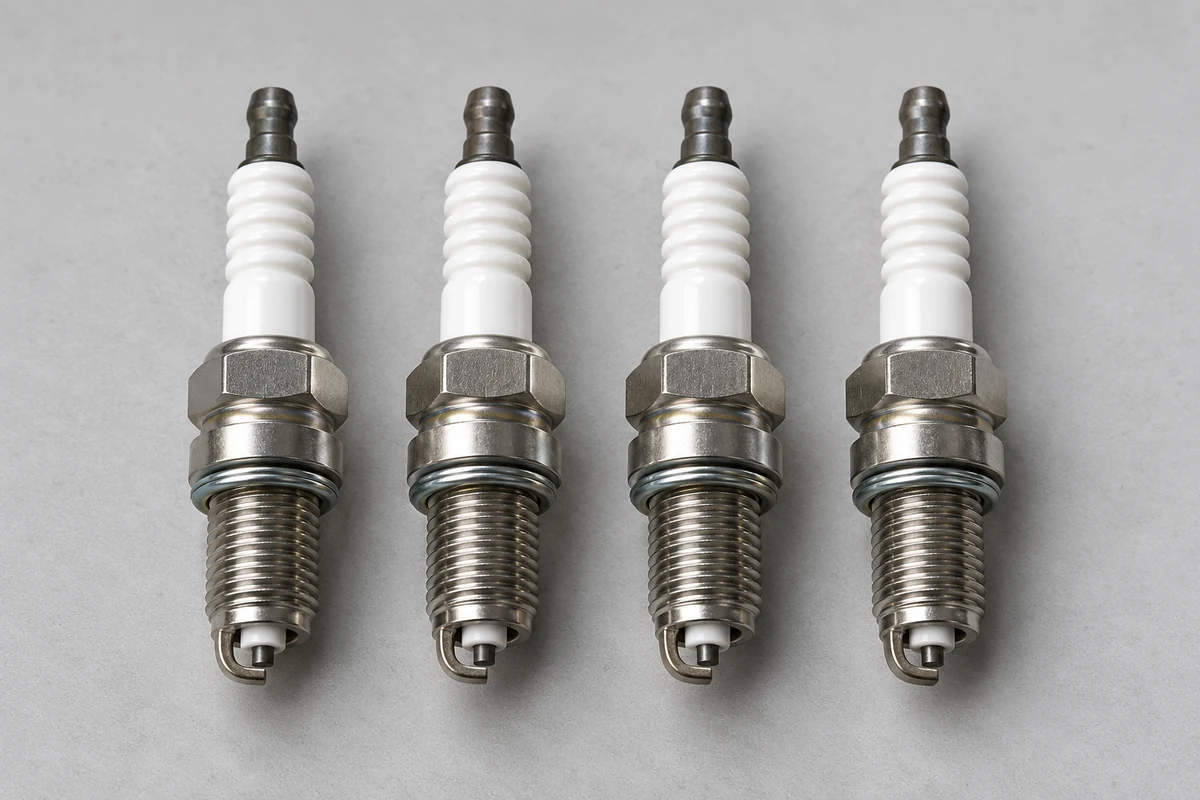
A spark-plug reorder can be wrong even when every stock row contains a legitimate identifier. One receipt may have been entered under the code on the plug and imported again under the numeric sales code on its box. Before applying either balance to demand, establish whether the rows represent different physical stock or two descriptions of the same stock.
This is a record-reconciliation decision for an already approved plug. It does not select a heat range, decode another brand or establish that two similar product codes are interchangeable.
Two identifiers can name one product
Niterra's NGK explanation distinguishes a plug number, printed on the plug, from a stock number used for sales inventory; the box carries both. Its example pairs DPR5EA-9 with 2887. The numeric stock code is not a heat-range or plug-type code. These are NGK-specific conventions checked on 14 October 2026. NGK part and stock numbers
That mapping establishes an identifier relationship. It does not prove that two warehouse rows are duplicates. Two separately received cartons of the same product remain two populations, whether their entry operators used different aliases or the same one. The question is therefore both “what product?” and “which receipt and physical group?”
Keep the complete plug designation, maker and sales identifier together. Do not strip a suffix or leading characters to force a match. Where the current mapping is unavailable, leave the proposed alias unresolved rather than merging on numeric resemblance.
Trace the rows back to the receipt
Compare each row's purchase line, receipt event, carton or traceable group, location and unit basis. A sales export and a stores export can report the same receipt without creating another carton. Conversely, two receipt references can describe distinct deliveries even where the quantities coincide.
Ask the record owner which entry is a view of another entry and which records a separate quantity. Preserve the response before changing planning. Avoid deleting a legitimate record merely because the product mapping is confirmed; the administrative correction should retain the old identifiers and the reason for the relationship.
Resolve pieces versus cartons at this point. A quantity of ten under one alias and one under another might be different units for one group. It might also be eleven pieces or eleven cartons across separate receipts. Only the actual conversion and receipt evidence can answer that question.
Build the alias reconciliation worksheet
| Field | Entry and decision |
|---|---|
| Physical plug population | Receipt and attributable group, not just a bin name |
| Plug number | Complete maker-specific designation |
| Sales stock number | Exact paired code and authoritative mapping |
| Alias evidence | Source, checked date and unresolved suffix questions |
| Unique eligible units | Quantity after population and unit reconciliation |
| Uncovered demand | Approved plug requirement after unique coverage |
One physical group should contribute once to the eligible balance. Existing holds and allocations remain applicable after an alias correction. Correcting a duplicate entry cannot release held stock or move a reservation to another job.
Fictional example: two rows, one carton
Assume a fictional approved plug has manufacturer-confirmed aliases P-A and S-A. A stores ledger shows 20 pieces under P-A; a sales import shows 20 pieces under S-A. Both entries trace to receipt R-A and the same carton group. This is an invented record, unrelated to the NGK example's actual stock.
The unique population is 20 pieces, not 40. If the approved remaining requirement is 28 pieces and all 20 are eligible and unallocated to other demand, eight pieces remain uncovered. Buying eight is still a proposal subject to the actual offer and purchasing authority; no pack size or delivery promise is assumed.
Now change one fact: S-A traces to a second confirmed receipt R-B containing another 20 eligible pieces. There are then 40 pieces, despite the alias relationship. Merging the product identity is appropriate; deleting one population is not. This counterexample is why a catalogue cross-reference alone must never trigger quantity deduplication.
Keep the correction useful next time
Retain a canonical product identity with both supported aliases, while preserving receipt-level quantities. Ask the system owner to address the specific import or naming mismatch rather than suppress every repeated code. Recheck only affected mappings when the offered designation changes; a new suffix should not inherit the old alias decision automatically.
The completed record should explain the original reported balance, the unique count and which pending demand remains. This is more useful than a lower total with no audit trail, and narrower than rebuilding the entire replenishment policy.
Request the identified replenishment
See Engine parts for category context. In an Autoparts sourcing request, identify the approved product and the unresolved replenishment question. The form accepts an 8–1200-character description or supported marketplace link, and up to five PNG, JPEG, WebP or GIF images, limited to 10 MiB each and 20 MiB total. Other technical files need a separately agreed, authorized exchange; the image field is not a PDF, CAD or ZIP portal.
Named manufacturer products are documentary examples, not branded supply offers, affiliation or evidence that another supplier can make or validate an alternative. Independent buying coordination and supplier negotiation do not establish fit, safety approval or guaranteed savings.
Frequently asked questions
Can a plug number and stock number identify the same spark plug?
Yes, under a documented maker-specific mapping. NGK explicitly uses both identifiers. Preserve the complete codes and current source, then separately establish whether the stock rows describe one physical receipt or several. Product identity alone does not settle quantity duplication.
Should I merge two rows with the same NGK mapping?
Merge their product identity only under the supported mapping; reconcile their receipt populations before combining quantities. Separate deliveries remain additive. Two exports of the same receipt must not be counted twice, and different units require an actual conversion.
Does the numeric stock number reveal heat range?
NGK says its sales stock number is not a heat-range or plug-type code. Do not extend that convention to other makers or select a replacement from numeric resemblance. Keep the already approved full plug designation as the requirement.
What if one alias cannot be verified?
Keep the affected quantity visible but unresolved for the proposed consolidation. Ask the product-data owner for the exact mapping and the stores owner for receipt evidence. Do not erase stock, assume interchangeability or cancel a purchase from a guessed alias.
Sources
Discuss a sourcing request related to this article.Spark-Plug Reorders: Reconcile Stock-Number Aliases