
Check Ignition Lead Boots and Terminals Without Pulling Them Apart
Check ignition lead boots, visible terminals and set identity without pulling cables apart or imposing a universal electrical acceptance value.
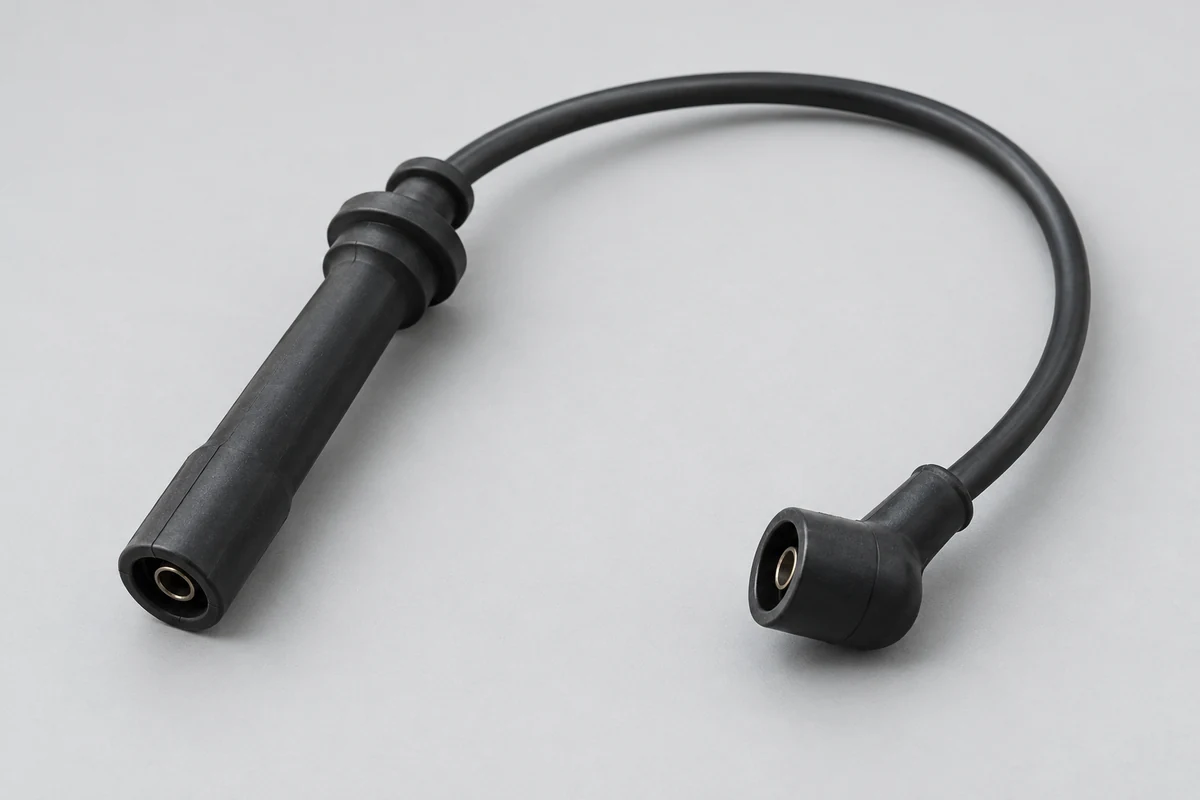
An ignition lead set can arrive with the correct set label while one boot has a folded lip, a visible terminal sits differently from the approved reference, or the individual lead identifiers cannot be reconciled. These are distinct reasons to ask for clarification. Keep each lead associated with the supplied set before anyone pulls on a cable or tries a connection.
The buyer’s question is whether the delivered set has a visible condition discrepancy or a broken identity trail. It is not whether the receiver can make every lead look alike. Different positions can legitimately use different ends; the approved set record controls that comparison.
Construction prevents a universal electrical shortcut
Niterra’s NGK overview distinguishes copper-core leads with resistance in the connectors, carbon resistance leads and inductive-resistance leads. The source also describes the wire and connector as parts of a lead. These distinctions provide background for requesting construction-specific evidence rather than imposing one generic resistance number on every set. They do not establish which construction an unknown delivered set contains. NGK lead construction overview
Keep a missing construction declaration separate from visible damage. If the order required a particular construction and the shipment document says only “ignition cable,” the evidence is incomplete. It does not prove the wrong conductor was supplied. Opening a boot or pulling a terminal to identify the conductor would change the item and is outside this receiving method.
Preserve the set-to-lead map
Start with the approved set reference and the supplied lead or position identifiers. Record how each visible lead maps to that document. Where identifiers are absent or unreadable, use temporary receiving labels for the record without inventing cylinder assignments. A length or colour resemblance is not an authorized position map.
Do not mix apparently matching leads from another set to produce a tidier collection. That can destroy the connection between one supplied set and its condition evidence. If the seller proposes an individual replacement, ask how it will be identified against the exact set and applicable construction. Do not assume interchangeability because the boot shape appears familiar.
Use the same documented viewpoint for a boot-mouth comparison where a safe existing view permits it. A terminal that looks recessed in an angled photo may be partly obscured rather than displaced. Record “appears recessed in view L-02” when that is all the evidence shows. Do not tug the cable to bring it forward or insert an object to establish depth.
Distinguish boot shape, terminal visibility and jacket condition
A folded boot lip is a visible shape concern. A torn area is a separate observation. A terminal that cannot be seen is an evidence limit rather than proof that it is missing. A jacket mark belongs on the particular cable section, not in a vague “set damaged” note.
Compare each concern with the actual approved design information. A generic stock photograph may show a different connector construction or a different end of the same lead. Ask the supplier to identify which end and position its explanatory image covers. An answer about a straight boot cannot resolve a disputed angled boot elsewhere in the set.
No ordinary exterior observation proves insulation behavior or conductor continuity. Do not add a plug-in trial, an energized check or a universal meter threshold to compensate for incomplete documentation. The intended result is an intelligible condition record for the responsible reviewer.
A lead-specific worksheet
Use one row per affected lead and end, with the whole-set record linked above it. This is an editorial aid, not an electrical test specification.
| Record | Useful detail | Unresolved decision |
|---|---|---|
| Set identity | Actual set code and approved revision | Does the supplied map cover this set? |
| Lead identity | Supplied identifier and mapped position, or unknown | Is the position traceable without guessing? |
| End and boot mouth | Which end; folded lip, tear or unclear feature | Intended geometry or physical departure? |
| Visible terminal | Existing view and comparison reference | Is the view sufficient to classify seating? |
| Cable jacket | Exact accessible section and observation | Is a condition assessment needed? |
| Construction evidence | Actual declaration and its product scope | Does the declaration answer the ordered construction? |
Leave a missing map visible even if every boot looks intact. Conversely, receiving the map does not clear a torn boot. These two paths can close on different dates and should have separate response references.
Fictional counterexample: pulling would answer the wrong question
In a fictional set S-7, lead L-A has a folded boot lip and L-B has a terminal that appears deeper than the approved image. The position map is missing. The seller suggests pulling L-B’s cable gently and says all the ends are the same. No real supplier or set is represented.
The buyer retains L-A’s shape concern, L-B’s terminal-view uncertainty and the absent map as three separate issues. Nothing is pulled apart. The next request asks for the set-specific map, identification of each compared end and a scoped response to the two observations. A general explanation about lead construction cannot substitute for those answers.
Suppose the supplier later provides the correct map and confirms that L-A’s lip differs from the agreed supplied condition. The map can close the identification question, while a remedy for L-A is considered. L-B remains unresolved if its photograph is still insufficient. There is no need to invent a “set passed” conclusion simply because one useful document arrived.
Request a coherent set outcome
Ask whether the proposed remedy concerns an individual lead or the complete set, how the replacement will be identified, and what evidence is still required for technical acceptance. Keep the commercial scope explicit without assuming a right to replacement. A returned lead and a replacement lead should not silently trade identifiers in the original record.
Keep the buying request tied to the actual part
For category context, see Engine parts; the supplier-check guide covers the earlier supplier review. Independent aftermarket or unbranded sourcing and authorized drawing-based proposals require their own product evidence. The manufacturer cited here is a documentary example, not an affiliation, branded-goods offer or endorsement of another supplier.
Start an Autoparts sourcing request with the exact received reference and the unresolved question. The form accepts an 8–1200-character description and up to five PNG, JPEG, WebP or GIF images, at most 10 MiB each and 20 MiB total. PDF, CAD and ZIP uploads are not supported. Arrange other technical files through a separately agreed, authorized exchange. Buying coordination and supplier negotiation do not establish an owned laboratory, an inspection service, engineering approval or a guaranteed remedy.
Frequently asked questions
Is one resistance limit suitable for every ignition lead set?
No universal value is supplied by this receiving method. The manufacturer overview identifies different constructions, so the actual ordered design and its applicable evidence must govern technical assessment. An exterior receiving review is not a resistance test.
Should I pull the cable if a terminal appears too deeply seated?
No. Record the accessible view and the exact end being compared, then ask for design-specific clarification. Pulling can change the supplied state and cannot establish whether the original appearance was intended or damaged.
Can lead length identify an unlabelled position?
Do not invent a position assignment from length or appearance. Request the map for the delivered set and retain unknown positions as unknown. A temporary receiving identifier can track an item without claiming its application.
Does a replacement for one damaged lead close the whole-set issue?
Only if all the separate conditions for that set have been resolved by the responsible owner. The replacement needs its own identity and arrival review; a missing map or another terminal concern does not disappear when one lead is replaced.
Sources
Discuss a sourcing request related to this article.Check Ignition Lead Boots and Terminals Without Pulling Them Apart