
Keep each coded injector with its own supplied record
Keep each coded injector with its already assigned trim record when consolidation moves the parts and media into new recipient packages.
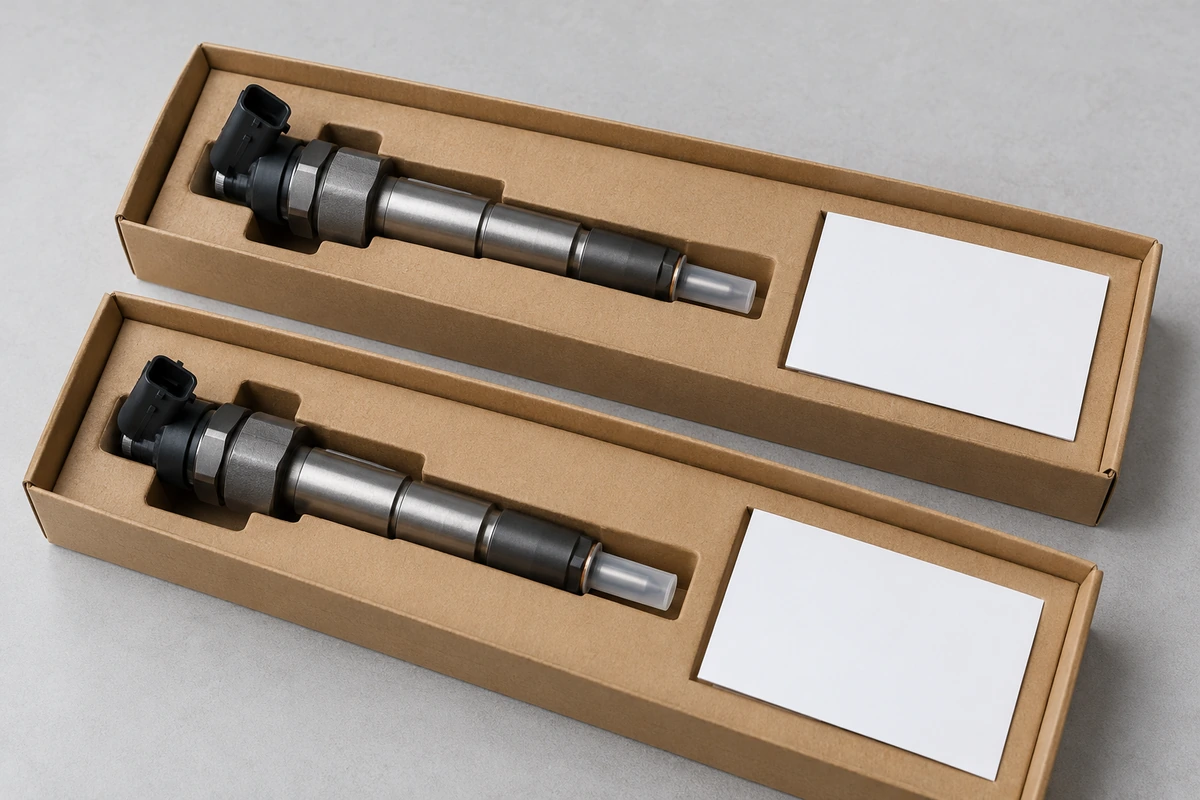
Where an approved injector offer includes individual trim data, the packing proposal must preserve which physical injector receives which supplied record. Consolidation can leave every injector and every record present while crossing those assignments. The buyer’s immediate question is whether the final package still contains the established injector-and-record pair.
This review assumes the actual coding requirement and the individual records have already been established. It concerns relocation of those paired supplied items when original cartons are changed. It does not retrieve missing data, substitute a report for online access or provide software, licensing or programming instructions.
Keep the heavy-duty example within its boundary
Delphi’s US trim-code product page, checked on 14 October 2026, states that its named remanufactured C7, C13 and C15 injectors have unique trim data supplied on a CD in the injector box. This is a heavy-duty product example. It does not establish the coding requirement or media format of a passenger-car injector offer.
For the actual order, ask the provider to identify the applicable individual-data requirement and the record actually supplied with each unit. If no individual record is part of the approved scope, do not add an invented coding deliverable. Where it is required, retain the provider-established pairing before evaluating a new carton arrangement.
A generic instruction leaflet has a different role from an individually assigned trim record. The presence of the leaflet in every final box cannot account for relocation of the actual unit-specific record.
Map the original pair into the final physical package
Use three connected references: the individual injector, its assigned record and the package that will receive both. A fourth reference may identify the original carton that previously kept them together. Use the actual provider identifiers and distinguish any buyer-created tracking shorthand from manufacturer markings.
The original carton may be the only place where the two supplied items are visibly grouped. If a revised layout retains the injector but moves its media sleeve into another pocket or carton, ask how the established assignment will remain evident. The concern is not whether a disc fits neatly in a pocket; it is which injector that pocket accompanies at handover.
Review an injector-to-record map in both directions. Given the injector, the final package record should identify its assigned supplied record. Given the record, the same evidence should lead back to the intended injector. A sequential carton number should not replace that individual relationship, especially when units change positions in a tray.
This original purchasing method does not read, interpret, generate or modify trim data. It records an established assignment supplied by the responsible product provider.
Distinguish a crossed packing proposal from lost attribution
A crossed proposal can be corrected on a documentary basis when the original assignments remain supported. Ask the provider to revise the final package mapping against that evidence. Keep proposal approval separate from confirmation of what was actually packed; a corrected schedule does not establish that the physical relocation has occurred correctly.
Lost attribution is a different problem. If nobody can establish which record belongs to an injector, moving a sleeve to a more plausible box does not resolve the uncertainty. Refer it to the responsible injector provider’s authorized process rather than assigning records by package order, a filename guess or visual similarity.
The record should therefore distinguish an established pair awaiting a revised packing location from a unit whose record assignment itself is unresolved. Both may prevent approval of the affected package, but they need different answers. The first needs a supported allocation; the second needs product-level attribution before the allocation can be settled.
Fictional example: both records are present, but their destinations cross
Imagine fictional injectors I-A and I-B, with provider-established individual records R-A and R-B. The original supply record pairs I-A with R-A and I-B with R-B. All four references are administrative examples, not manufacturer identifiers or actual trim codes. Both supplied records are available; no document retrieval is missing.
A consolidation proposal places I-A in final package P-1 and I-B in P-2. Its separate media-placement schedule sends R-A to P-2 and R-B to P-1 after the tray positions were reversed. The total is two injectors and two records, yet each proposed recipient package contains the other unit’s record.
The buyer asks the provider to reconcile the two placement schedules with the original individual assignments. Adding a note that both records are somewhere in the shipment does not resolve the recipient package. Nor does approval of the new outer carton approve the crossed media allocation.
Suppose the provider supplies a corrected map that pairs I-A and R-A in P-1, and I-B and R-B in P-2. That resolves the proposed allocation if the underlying attribution is still supported. Any evidence of packing execution must identify that corrected revision; it should not be inferred from an earlier photograph or from unchanged item totals.
Now suppose the original pairing record was never established. The same tidy map would be unsupported, even though its letters appear to match. The buyer must obtain product-provider attribution before approving it. Administrative symmetry cannot create individual technical identity.
Close the pair at the recipient boundary
The final packing record should name each injector, its already attributed supplied record and their joint destination package. Keep any established pair that is split between packages explicit, with the provider’s proposed recipient arrangement and the buyer’s decision. Do not leave the recipient to infer pairing from the order in which boxes are opened.
A supported pairing record answers what accompanies each unit. It does not verify the trim data’s meaning, injector function, vehicle compatibility or successful programming. Any later technical work remains outside this packing decision.
Bring the actual proposal into the sourcing request
See Engine parts for category context and the supplier-check guide for the earlier supplier review. The manufacturer example above does not establish affiliation, a branded-goods offer or another supplier’s capability. Independent aftermarket or unbranded proposals need their own attributable evidence.
An Autoparts sourcing request can identify the approved product and the specific packing change still awaiting an answer. The form accepts an 8–1200-character description and up to five PNG, JPEG, WebP or GIF images, at most 10 MiB each and 20 MiB total. It does not accept PDF, CAD or ZIP files; arrange other technical files through a separately agreed, authorized exchange. Buying coordination and supplier negotiation do not establish an owned factory or laboratory, specialist packing services or engineering approval.
Frequently asked questions
Does every injector require an individual trim record?
No universal requirement follows from this article. The cited Delphi example concerns named heavy-duty C7, C13 and C15 remanufactured injectors on its US page. Establish the requirement and supplied record for the actual offer, especially for passenger-car products, before reviewing how an existing individual pairing will be preserved.
Can a package be incomplete even when all injectors and records are present?
Yes, if the proposal places an injector in one recipient package and its assigned record in another. The shipment total accounts for presence but does not establish the correct individual pairing at handover. Reconcile the original provider assignments with the final injector and media placement records.
What evidence resolves a crossed media-placement schedule?
Use the already supported injector-to-record assignments to obtain a corrected final package map from the provider. Identify which revision is accepted and keep evidence of actual packing separate. A revised schedule resolves the proposal; it does not by itself prove that the physical packages were corrected.
Can matching new labels restore an unknown injector-to-record assignment?
No. Buyer labels can carry forward an established pairing but cannot create missing technical attribution. If the original relationship is unresolved, refer it to the responsible injector provider before accepting a new package map. Do not assign records by their order, appearance or a programming attempt.
Sources
Discuss a sourcing request related to this article.Keep each coded injector with its own supplied record