
Mixed repair parts: price customs entry lines without equating them to SKUs
Ask how the broker counts chargeable customs entry lines and handles duty advances for a mixed repair-parts shipment; warehouse SKUs are not a fee basis by themselves.
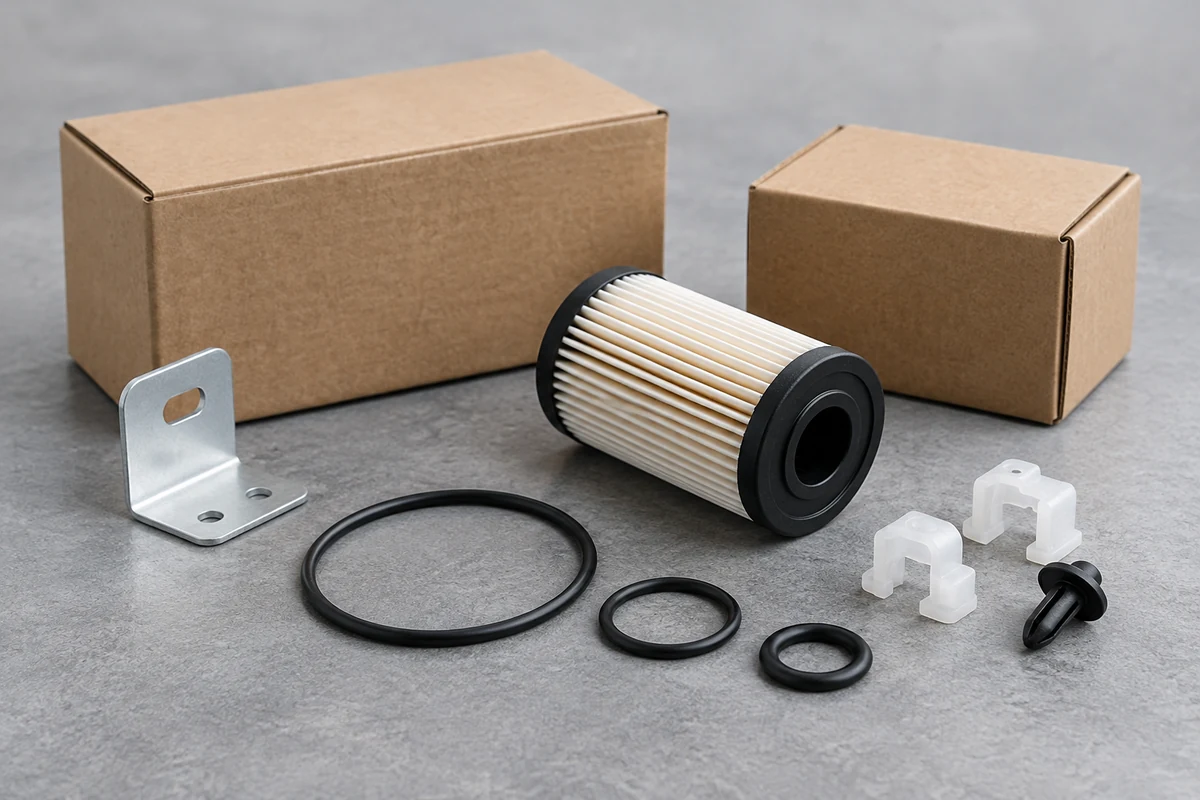
For a mixed repair-parts shipment, ask the broker how it arrives at the chargeable customs entry-line count. The warehouse's SKU count, carton count and broker's entry lines are different records. A fee estimated from the number of coloured bags may not describe the service the broker will actually charge for.
Then ask separately about any charge for advancing or processing duties and taxes. A clear entry-line answer does not settle that second cost. This article reviews the broker's commercial charging basis; it does not assign tariff codes or tell the buyer to combine declarations to reduce fees.
Give the broker a truthful mixed-parts basket
Provide the actual item list with descriptions, quantities, supplier references and available origin evidence. Distinguish clips, sensors, gaskets and other goods rather than describing every line as spare parts. Where a fact is missing, identify the gap and who can supply it.
Keep internal stockkeeping variations visible without assuming their customs treatment. Several warehouse SKUs might differ only in a purchasing attribute, while another line could represent a materially different product. The responsible broker needs the underlying facts to explain its actual grouping and service quotation.
Do not use the seller's location as automatic proof of origin. Give the broker the available attributable records and request the evidence it needs. This article establishes no origin or preferential treatment for any goods.
Request the provider's counting rule
UPS's US rate-update page separately identifies an additional-entry-line charging basis and a duty/tax disbursement fee, with dated changes. It illustrates that these are distinct cost mechanisms. It does not tell this buyer how many entry lines its mixed basket will require or provide a global fee schedule. UPS US rate updates
Ask the actual broker which date, service and account terms apply. Request its proposed chargeable line count, any included allowance and the basis for additional lines. Have it map that estimate to the actual basket sufficiently clearly that the buyer can identify a later scope change.
The broker may need its classification assessment before fixing the count. Retain that dependency. Do not force an early number by grouping items yourself or suppressing a distinction the broker needs for an accurate declaration.
Separate the entry service from the duty advance
For any disbursement or advancement charge, ask what amount it is calculated on, whether a minimum applies and which party is paying or processing the government charges. Use the actual provider's terms and quote rather than copying a percentage from another service.
Keep duties and taxes themselves in their own fields, supported by the responsible assessment. A charge for processing them is not the underlying government amount. Likewise, a bundled brokerage offer may include an entry service while leaving an advancement fee outside; ask the provider to say so explicitly.
If the provider offers another payment arrangement, obtain its actual terms before comparing it. This article does not recommend a credit arrangement or assert that a buyer can avoid a fee. The useful task is to understand which services and payment responsibilities the quoted sum covers.
| Mixed-parts cost field | Provider evidence |
|---|---|
| SKU descriptions | Actual basket revision and relevant product facts |
| Origin evidence | Attributable records and unresolved questions |
| Broker grouping | Explanation tied to the proposed declaration scope |
| Entry lines | Estimated or confirmed count and applicable fee basis |
| Disbursement basis | Amount processed, applicable formula and payer |
| Actual fee quote | Inclusions, exclusions, date and account terms |
Fictional comparison: clip colours counted as declaration lines
Imagine a fictional basket containing several clip colours and unrelated sensors. A buyer multiplies every warehouse SKU by a remembered per-line fee and calls that the clearance budget. The broker has not assessed the grouping or confirmed its current terms. No actual count, rate or classification is represented.
The buyer sends the complete basket for review and asks the broker to state its own line-count basis. It also asks whether the quote includes any duty/tax advancement charge. The final comparison uses the returned service explanation, while unresolved government amounts remain clearly marked.
If the supplier later adds another product, send the changed basket back to the broker. The old line count may or may not remain appropriate; let the responsible provider explain. Do not delete the added item from the paperwork merely to preserve a lower fee.
Reconcile the invoice against the reviewed basket
Retain the quoted count, fee terms and basket revision so any later invoice can be queried accurately. Ask whether a difference came from changed goods, an assessed declaration requirement or a service-term change. This supports a specific billing enquiry without treating every extra line as an error or equating every SKU with a customs line.
The primary guidance cited here was checked on 14 October 2026. Recheck the applicable current rules and provider terms before committing to the actual shipment.
Keep the buying enquiry within scope
For product context, see Engine parts. The Autoparts sourcing request can start an independent aftermarket or unbranded buying enquiry with a short description or supported product link. It accepts up to five PNG, JPEG, WebP or GIF images, at most 10 MiB each and 20 MiB total; descriptions are 8–1200 characters. Arrange other documents through a separately agreed, authorized exchange. The form is not a PDF, CAD or ZIP portal.
Supplier information and negotiation do not establish product suitability, specialist transport acceptance or customs approval. Keep those decisions with the responsible qualified parties. No freight service, branded-product offer or guaranteed outcome is implied here.
Frequently asked questions
Is one warehouse SKU always one customs entry line?
Do not assume that relationship. Give the broker the actual product and origin facts and request its grouping and chargeable-line basis for the proposed service.
Can I combine different parts into one description to reduce brokerage fees?
Do not distort the goods description or suppress relevant distinctions. The responsible broker must determine accurate declaration treatment from the actual basket.
Is a disbursement fee the same as customs duty?
No. Ask the provider to distinguish the underlying government amounts from its service charge for advancing or processing them, using the actual quote terms.
Can I copy the published UPS US line fee into any China shipment budget?
No. Confirm the actual provider, destination, service, account terms and effective date. The cited page is a bounded US example, not a universal rate or a determination of your line count.
Sources
Discuss a sourcing request related to this article.Mixed repair parts: price customs entry lines without equating them to SKUs