
Wiper Motor RFQ: Motor Only or Linkage Assembly?
Define the required wiper motor, transmission or linkage, arms and blades separately before comparing a motor price with an assembly quote.
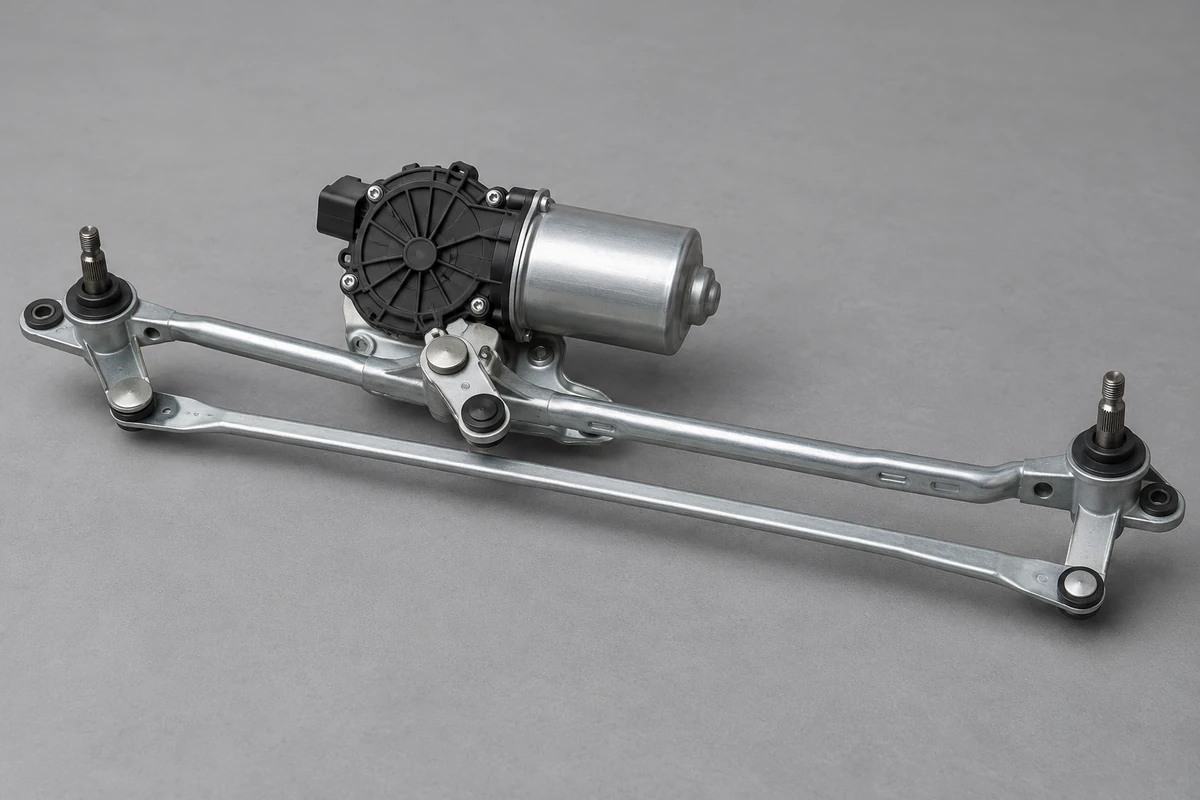
A wiper-motor price and a motor-and-linkage assembly price answer different purchasing requests. Define the required supplied boundary before comparing them. The seller should not decide which linkage or other components will be retained merely by leaving them outside a low-priced offer.
Start with the replacement scope already established for the actual vehicle/application. This article does not diagnose a failed wiper system or decide whether existing parts can be reused. Its focus is the relationship between the requested assembly and the components the supplier actually prices.
Identify the assembly boundary behind the category name
Dorman’s body-products page presents 602-230AS as a windshield wiper motor and transmission assembly, and describes the relevant combined scope as motor plus transmission/linkage. That category example does not establish that arms, blades or every application variant are included. Dorman body-products assembly example
Use the example to separate motor-only from combined assembly wording. Do not borrow the manufacturer’s labor, performance or replacement claims for an unbranded candidate. A category page is a scope illustration, not sufficient evidence for the exact vehicle being sourced.
Ask the supplier to name the actual motor and assembly reference it offers. If it uses transmission and linkage differently from the buyer’s documents, request an itemized explanation. Do not assume a familiar word guarantees the same group of supplied components.
Keep arms and blades outside the shorthand
List motor, transmission/linkage, arms and blades as separate contents questions. Each may be required, excluded or outside the authorized purchase, but the answer must be explicit. “Complete wiper assembly” should not force the buyer to infer where completeness ends.
Do not expand an authorized motor/linkage request into a full set of arms and blades automatically. The worksheet’s purpose is to identify the actual boundary, not maximize the component count. If those items are outside scope, state that clearly so a later reader does not mistake the assembly name for their inclusion.
Likewise, do not reduce the required assembly because a supplier suggests using existing linkage. Retained-component suitability is a technical decision based on the actual vehicle and condition, not a purchasing assumption. A cheaper motor-only line does not establish it.
Treat controls as a separate evidence question
An included motor and a matching connector photograph do not establish the required control compatibility. Request the product-specific application and control-scope evidence appropriate to the authorized assembly. Keep unknowns visible rather than proposing wiring changes, park-setting work or a powered bench check.
A drawing-based linkage proposal may describe geometry without establishing the complete assembly’s application. Ask which supplied component the drawing covers and which requirements remain outside that proposal. Do not merge a mechanical drawing, an unrelated motor listing and a bundle price into a nonexistent accepted assembly.
A motor/linkage scope worksheet
| Item | Required purchase boundary | Exact supplier response |
|---|---|---|
| Vehicle/application | Authorized reference and variant | Offered assembly identity and supporting evidence |
| Motor | Included or authorized motor-only request | Exact motor supplied within the offer |
| Transmission/linkage | Required assembled scope | Included components or explicit exclusion |
| Arms | Required, optional or excluded | Identities and counts if included |
| Blades | Required, optional or excluded | Identities and counts if included |
| Controls | Application-specific evidence requirement | Supplied documentation or unresolved gap |
| Price basis | Defined supplied assembly | One assembly price with options separate |
The list is a purchasing aid. It does not prescribe linkage geometry, timing or a reassembly sequence. Its value is that every supplier answers the same purchased-object question.
Fictional comparison: a motor quote with a hidden retention assumption
A fictional buyer needs an established motor-and-linkage assembly. Offer A quotes one motor and says the existing linkage can be used, without an authorized assessment. Offer B names the motor/linkage assembly but leaves arms, blades and control evidence unanswered. No real supplier capability or product acceptance is represented.
A does not meet the requested boundary. Ask for the required assembly if available, and do not treat its retention statement as technical permission. Adding an estimated linkage cost would not identify or accept a complete combination either.
B answers the main assembly boundary but still needs clarification. Ask it to state whether arms and blades are included or excluded and to supply the application/control material required by the responsible reviewer. If the approved request excludes arms and blades, B can answer those rows with explicit exclusions; a larger bundle is not inherently better.
If B later quotes a motor-only alternative, retain that as a separate proposal. Do not combine the original assembly description with the revised motor price. The consolidated response should make the actual supplied object unmistakable.
Compare the right assembly commercially
Ask for same-scope pricing, actual order quantities and separately identified options. An aftermarket or unbranded proposal should state its own references and evidence. Named catalogue examples do not establish availability, branded supply or equivalence of another seller’s product.
Keep the buying decision distinct from the separate blade-side/heating question. That question matters when blades are actually in scope, but it cannot resolve whether the motor and linkage are supplied. Here the RFQ is complete enough for review when it states the motor/linkage boundary, accessory exclusions and outstanding application/control evidence without assuming reuse or adaptation.
Prepare the sourcing request
For the broader product group, see Body parts. If the application is not established, start with the OE and application identification guide before asking for a substitute.
Use the Autoparts sourcing request to describe the required item and the particular question left open above. The form accepts a description of 8–1200 characters and up to five PNG, JPEG, WebP or GIF images, limited to 10 MiB each and 20 MiB total. It does not accept CAD, PDF or ZIP attachments. Authorized drawing images can start a discussion; arrange other technical files separately through an actually agreed, authorized exchange.
Keep requests for independent aftermarket or unbranded alternatives tied to the authorized application or drawing. Supplier negotiation and a drawing-based proposal do not establish engineering acceptance, actual manufacturing capability or guaranteed savings. Named catalogue products in this article are documentary examples, not branded-goods offers or approvals of an unknown alternative.
Frequently asked questions
Is a wiper motor quote the same as a motor-and-linkage assembly quote?
No. The supplied objects differ. State the authorized boundary and ask each supplier to identify the motor and transmission/linkage components included. Do not assume that existing linkage can be retained simply because it is excluded from a lower price.
Does a complete wiper assembly include arms and blades?
Not necessarily. Ask separately about arms and blades and preserve their included, optional or excluded status. The actual approved purchase may not require them, so the goal is an explicit boundary rather than the largest possible bundle.
Can matching connectors establish wiper motor control compatibility?
No. Connector appearance does not establish the required application and control behavior. Request the appropriate product-specific evidence and keep unanswered requirements with the responsible reviewer; do not use adaptations or powered checks to fill the documentary gap.
How should a custom linkage proposal be compared?
Identify exactly which component the authorized drawing covers and how it relates to the requested supplied assembly. A mechanical proposal does not validate an unrelated motor or complete system. Keep missing application/control evidence and all included components explicit.
Sources
Discuss a sourcing request related to this article.Wiper Motor RFQ: Motor Only or Linkage Assembly?