
Record Receiver-Drier Port Exposure Before Repacking
Record receiver-drier closure state and unknown exposure history before repacking, without inventing safe-open times or diagnosing desiccant condition.
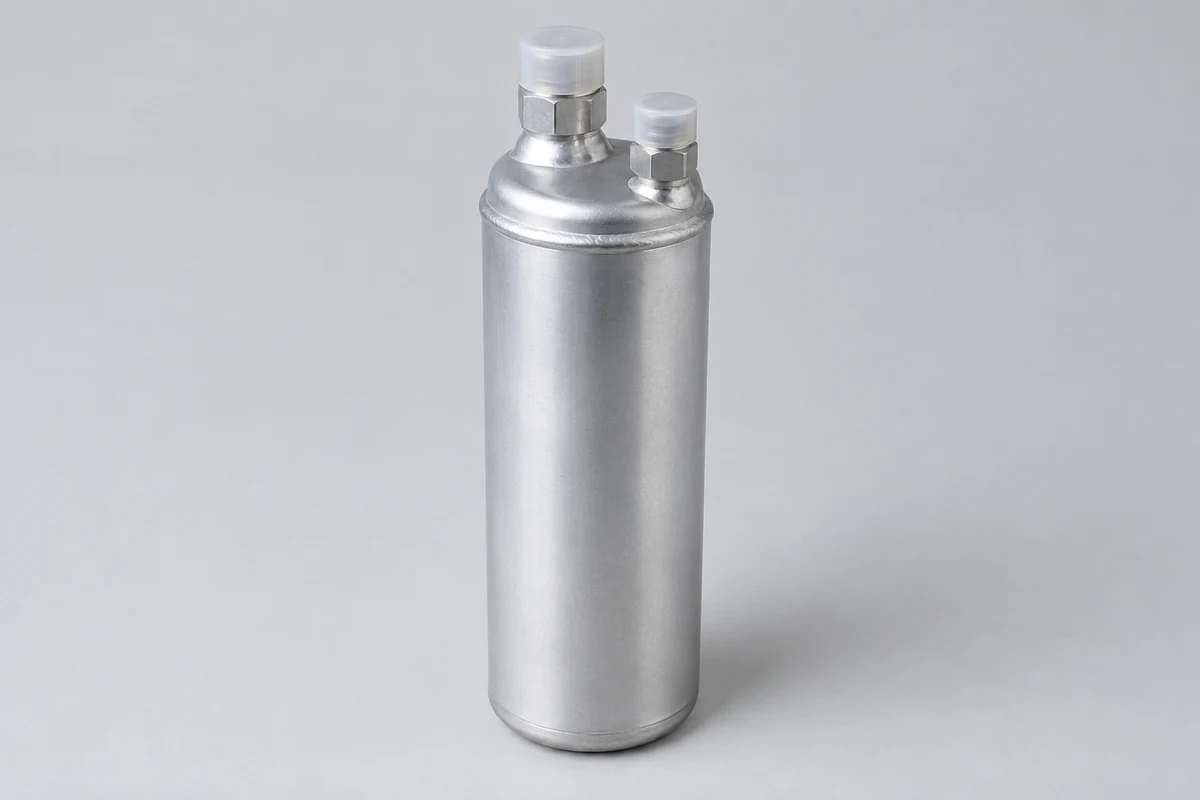
A loose or detached supplied closure on a receiver drier creates a history question that repacking cannot erase. Record what was open when it was observed, what the applicable product record expected, and how much of the earlier exposure history is actually known. Do not start a guessed safe-exposure countdown or declare the desiccant saturated from appearance.
The buyer’s decision concerns an already specified, unused drier whose supplied protection is in question. It is not a procedure for drying, regenerating or installing the part. Keep the unit traceable while the supplier and responsible technical owner address the missing history.
Moisture function explains the question, not the answer
DENSO describes receiver driers as filtering contaminants and absorbing moisture. Its overview also distinguishes receiver driers from accumulators by their system roles. That background explains why an exposure concern is relevant, but the page supplies no universal period for which an open delivered drier is acceptable. DENSO receiver-drier overview
Do not infer a saturation threshold, humidity limit or remaining capacity from the outside of the part. A clean-looking port does not reveal the internal condition. Conversely, a cap found off does not by itself establish exactly when it detached or the degree of moisture exposure.
The product identity must remain fixed. A seller’s suggestion to send a similar-looking accumulator is a different product proposal, not a way to close the drier’s exposure record. Any alternative requires its own authorized application and technical review.
Establish which closure was actually expected
Use the agreed supply specification, packing information or applicable manufacturer documentation to identify the expected closure arrangement. Do not assume every drier uses the same cap, bag or sealing method. A missing item is a discrepancy only against a relevant expectation, while an unclear expectation is a documentation gap to resolve.
Describe each affected port separately where the available view permits. A detached cap lying in the carton, a cap that appears loose and an apparently intact closure are different observations. Do not open another port for comparison or manipulate the suspect closure to determine how easily it moves.
If packaging obscures the port, retain that limit. The desire for a complete photographic checklist should not lead to unnecessary exposure. Any protective handling after the initial record needs an identified responsible person and applicable product guidance; this article does not prescribe a universal recapping or repacking operation.
Separate observation time from exposure duration
“Cap found detached at 09:20” records the discovery time. It does not mean exposure began at 09:20. Likewise, a shipping date establishes a transport event, not the moment a closure changed state. Preserve known events and unknown intervals separately.
Ask whether the supplier or consolidator has an attributable packing, opening or repacking record for this unit. A photograph of a closed drier at dispatch may provide one earlier observation, but it does not show uninterrupted closure throughout the journey. A later sealed photo also cannot prove the condition before it was sealed.
Do not calculate an exposure duration by subtracting timestamps that describe different events. If the history is incomplete, write “prior exposure duration unknown” and leave the implication to the responsible technical decision. Uncertainty is the issue to resolve; it is not a defect percentage to estimate.
An exposure-history worksheet
This original editorial worksheet links a closure concern to its documentary limits without creating a moisture test.
| Record | Useful entry | Limit that stays visible |
|---|---|---|
| Drier identity | Exact ordered and delivered reference | Similar housing does not establish product role |
| Expected protection | Applicable closure/packing requirement | No universal cap mandate is assumed |
| Observed port state | Which port, original view and cap location | External view cannot establish internal moisture |
| First observation | Time, observer and package state | Discovery time is not exposure-start time |
| Earlier history | Attributable packing or repacking records | Gaps remain unknown intervals |
| Next disposition | Exact-unit technical response and agreed handling | A new closure does not reset the historical question |
Record any protective action already taken as a later event, with its source and timing. Do not replace the initial “cap detached” entry with “cap fitted” as though the first event never happened. Both belong in the chronology.
Fictional counterexample: recapping does not reset the clock
A fictional drier D-5 arrives with a supplied cap detached inside its carton. The order’s packing record establishes that this port was to be supplied closed. The receiver first notices the condition on opening, but no reliable earlier exposure time exists. These details are invented.
The seller proposes putting the cap back and treating the unit as sealed stock. The buyer preserves the original state in the record and asks for a product-specific disposition that addresses the unknown interval. Any subsequently authorized protective handling is recorded separately; it cannot establish that the cap stayed in place before arrival.
Suppose a dispatch photo later shows a cap in place on an apparently matching drier. The buyer first checks whether it is reliably linked to D-5. Even if that link is established, the photo describes one prior moment. It does not supply a continuous exposure record or a safe number of open minutes.
The responsible technical owner may still require an agreed replacement or another qualified outcome. The worksheet does not prescribe that outcome, determine warranty rights or diagnose exhausted desiccant. Its value is preserving the exact uncertainty instead of hiding it under new packaging.
Keep an unresolved history visible through the remedy
A useful supplier response names the actual drier, addresses the applicable protection requirement and explains the basis of its proposed disposition. If replacement is agreed, link its new receiving record to the original issue. A new cap, a revised label or a dry-looking exterior should never silently become proof that the original exposure concern was resolved.
Keep the buying request tied to the actual part
For category context, see Cooling parts; the supplier-check guide covers the earlier supplier review. Independent aftermarket or unbranded sourcing and authorized drawing-based proposals require their own product evidence. The manufacturer cited here is a documentary example, not an affiliation, branded-goods offer or endorsement of another supplier.
Start an Autoparts sourcing request with the exact received reference and the unresolved question. The form accepts an 8–1200-character description and up to five PNG, JPEG, WebP or GIF images, at most 10 MiB each and 20 MiB total. PDF, CAD and ZIP uploads are not supported. Arrange other technical files through a separately agreed, authorized exchange. Buying coordination and supplier negotiation do not establish an owned laboratory, an inspection service, engineering approval or a guaranteed remedy.
Frequently asked questions
How many minutes can a receiver drier safely remain open?
This article and the cited overview supply no universal exposure allowance. The actual product guidance and known history must be assessed by the responsible technical owner. Do not invent a safe interval from a shipping or discovery timestamp.
Does replacing a detached cap restore the original receiving condition?
It may describe a later protective action if properly authorized, but it cannot erase the earlier open state or unknown exposure history. Preserve both events and keep technical disposition separate from the appearance of a resealed package.
Can I tell whether the desiccant is saturated by looking into the port?
An ordinary exterior view does not establish internal moisture condition, and this method does not call for looking or probing inside. Record the accessible closure evidence and request product-specific disposition without a visual saturation diagnosis.
What if the supplier provides a dispatch photo with the cap fitted?
Verify that it covers the actual unit or traceable shipment scope. The photo can document one earlier state, but it does not prove uninterrupted closure. Any gap between dispatch and receipt remains a history limit for the technical reviewer.
Sources
Discuss a sourcing request related to this article.Record Receiver-Drier Port Exposure Before Repacking