
Reman Caliper Reorders: Match Banked Cores Before Relying on Credit
Match existing core-bank entries to an approved caliper reorder, preserving exact references, timing evidence, prior uses and unresolved balances.
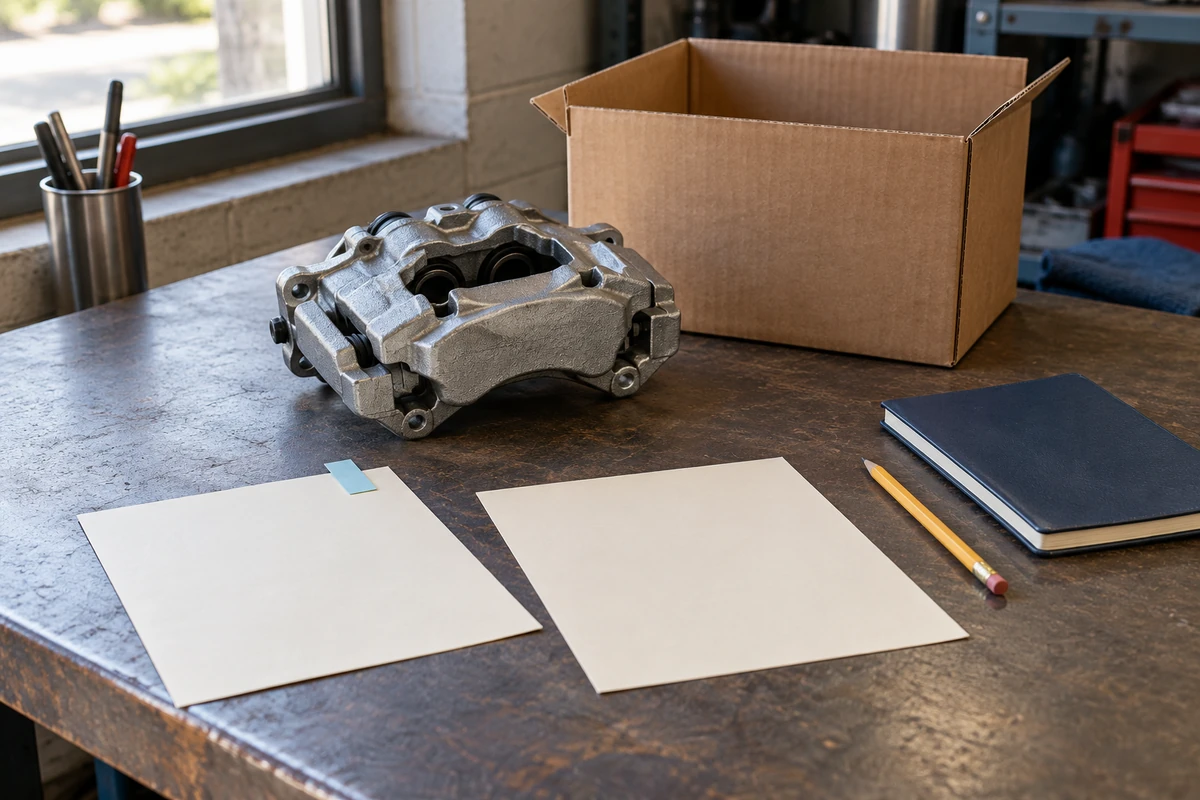
An existing core-bank balance can look like a reason to expect credit on the next remanufactured caliper order. Before carrying that expectation into the purchase proposal, match the recorded entries to the exact order line through the responsible program account owner. A total balance cannot answer which entries support this purchase, remain unresolved or have already been used.
Start with an independently approved replacement reference and reorder quantity. Physical replacement coverage has already been settled. The task here is narrower: prepare a dated purchase-to-bank match schedule showing the evidence behind each expected account adjustment.
Obtain the entry history behind the balance
Ask the party responsible for the actual core-program account for a dated report and the applicable terms. Retain the program, account, report date, entry IDs, recorded returned references, quantities and current statuses. Keep earlier snapshots available so a later change can be explained.
A remembered total such as “four calipers in the bank” omits the information needed for a match. Those four may span different references, include an entry used by an earlier order or carry an unanswered timing condition. Ask for the specific records rather than copying the total into the next purchase request.
Keep account boundaries explicit. If two branches or suppliers appear in the records, ask which account owns each entry and which account will make the proposed purchase. Do not combine their balances unless the responsible program party confirms that treatment for the actual transaction. Request only the relevant records through the authorized channel; a buyer does not need another customer's account history.
Resolve the exact purchase match
ZF's European Core Return Guidelines, revision 01_2026, cover authorized direct customers returning purchases within its surcharge program. Excess returns do not produce an immediate refund. Page 5 describes overreturns banked by core type; page 7 requires a matching purchased part number and says unmatched entries are removed if the relevant return limit is missed. Page 6 measures the return period from invoice issue and distinguishes core types. Applicable limits appear in the system and reports. The guidelines do not supersede governing documents, and acceptance conditions remain separate. ZF European core-return guidelines
That named example explains why a family label alone is insufficient evidence for the buyer's proposed match. Preserve three separate fields: the family description, the original returned reference and the exact proposed purchase reference. Ask the account owner to connect the particular bank entry to the particular purchase line, stating the quantity and conditions supported.
A catalogue substitution accepted for the vehicle does not itself establish a core-program match. If the proposed replacement reference changes, obtain the commercial mapping answer for that reference as well. Do not silently edit the returned reference to make two rows look identical. A positive response should identify the records it covers; a broad “calipers qualify” reply leaves the line-level question unanswered.
Establish the timing condition and its event
For each candidate entry, record the applicable document or report, the event that starts the period, the corresponding date and the event the proposed purchase must satisfy. Have the account owner identify which invoice and which purchase event matter for this entry. The source example supplies no universal number of days for this buyer.
A planned order date is not evidence that the required event has occurred. If an answer depends on an invoice being issued, for example, an internal purchase approval cannot be substituted for that invoice. Keep the planned event, the owner's confirmed timing basis and later evidence of what actually happened in separate fields.
If the start date or qualifying event is missing, mark the row awaiting timing. Do not calculate a convenient deadline from the date the report was downloaded. Where a proposed purchase moves, ask whether the existing response still covers it before retaining the expected treatment. This is a review of the changed assumption, not a promise that an extension is available.
Prepare a purchase-to-bank match schedule
Use one row for each proposed association. Where an entry needs to be split across purchase lines, retain its common entry ID and reconcile the combined proposed quantity against its confirmed remaining balance. This prevents two planners from relying on the same entry independently.
| Field | Record to preserve |
|---|---|
| Approved reorder | Purchase line, exact replacement reference and independently approved quantity |
| Program and account owner | Actual account and party authorized to confirm treatment |
| Report and entry | Report date, original bank entry ID and recorded returned reference |
| Remaining quantity | Current reported balance and attributable prior-use history |
| Match evidence | Owner response linking this entry, purchase line and quantity |
| Timing basis | Governing source, start event and date, qualifying event and applicable limit |
| Proposed association | Quantity entered once in this review schedule |
| Evidence status | Supported candidate, awaiting match, awaiting timing, previously used or unsupported under stated conditions |
| Expected treatment | Exact scope and conditions of the attributable account response |
| Residual entry | Unassociated quantity and the specific reason it remains open |
| Closure | Later account evidence, reconciliation owner and review date |
“Supported candidate” means evidence supports the proposed association under its stated conditions. It does not mean a credit has posted. The schedule itself neither changes a program balance nor authorizes a deduction from an invoice.
Before relying on the schedule, ask the account owner whether relevant changes have occurred since the report. Preserve pending associations with other purchase proposals as well as completed uses. If two proposals compete for an entry, the responsible owner must resolve the conflict; a second spreadsheet does not create a second balance.
Work through a partially supported reorder
Assume an entirely fictional approved replenishment of four replacement calipers, reference R. An account report contains entry A for two units, B for one unit and C for one unit. All identifiers, quantities and responses below are invented; none describes a real program account.
For A, the responsible account owner supplies a written match to the proposed R purchase and confirms the timing condition is satisfied for the intended qualifying event. B's recorded-reference mapping remains unanswered. Account history shows C was associated with an earlier purchase.
| Fictional entry | Recorded quantity | Treatment in this purchase review |
|---|---|---|
| A | 2 | Supported candidate association with the R line, subject to the recorded conditions |
| B | 1 | Awaiting mapping; excluded from supported expected treatment |
| C | 1 | Previously used; excluded from this purchase's association |
The result is two supported candidate units for review, one unresolved mapping and one previously used entry. It is not four units of available credit. No recovery amount or payment offset can be calculated from these facts. The independently approved replenishment remains four R calipers.
If the intended qualifying event changes, obtain an updated response for A before carrying its expected treatment forward. If B later receives a supported match and timing answer, add the evidence and revise its status without erasing the earlier uncertainty. C cannot be reused because it still appears in an older export; retain its earlier-purchase link in the history.
Carry the confirmed assumption through to account closure
Give the purchasing owner the schedule, supported candidate associations and unresolved exceptions together. State which account response underpins each expected adjustment and which conditions remain. If no recovery is supported, retain the already justified reorder on its actual approved terms; any change to the purchase requires the buyer's normal authorization.
After the relevant event, reconcile the actual account record with the proposed association. Link a posted adjustment to the specific entry and purchase it concerns. If the outcome differs, ask the responsible account owner to explain the affected row rather than marking the entire bank settled. Preserve unassociated entries and their open questions for a later eligible purchase review.
An approaching program limit may make an evidence request urgent, but it does not create a need for extra calipers. Keep replenishment justified by the approved requirement. The useful output is a traceable account assumption, including where the evidence stops.
Ask about the identified replacement purchase
See Brake parts for category context. An Autoparts sourcing request can identify the approved replacement reference and the unresolved purchasing question. Keep account-specific records with their authorized recipients; arrange any necessary document exchange separately.
Autoparts provides independent buying coordination and supplier negotiation. The manufacturer example establishes no affiliation, branded supply offer, access to CorExpedia, core valuation or ability to administer an account or recover a deposit. Product approval and program treatment remain with their responsible owners.
Frequently asked questions
Does a core-family description prove my caliper reorder qualifies?
No. Ask the responsible account owner to identify the exact bank entry, recorded returned reference, proposed purchase reference and supported quantity. A family label or vehicle-fit substitution does not establish that commercial match. Keep any unanswered mapping outside the supported purchase assumption.
Can I subtract expected core credit from the next invoice?
This match schedule grants no payment-netting right. Record the account treatment actually agreed for the transaction and obtain the appropriate payment authorization. An expected adjustment, an owner-supported candidate and a posted credit are different states; none should be silently substituted for another.
What deadline should I use for an existing core-bank entry?
Use the applicable current program record and the account owner’s entry-specific answer. Preserve the starting event and date, the qualifying purchase event and the source of the limit. If any element is missing, keep timing unresolved; do not invent a day count or use the report-download date as the start.
Should I order extra calipers to use the bank balance?
A possible account recovery does not establish replacement demand. Keep the existing approved quantity as the purchasing basis and disclose unsupported recovery assumptions. Any larger order needs its own demand rationale and normal authorization, rather than being justified solely by an unused bank entry.
Sources
Discuss a sourcing request related to this article.Reman Caliper Reorders: Match Banked Cores Before Relying on Credit